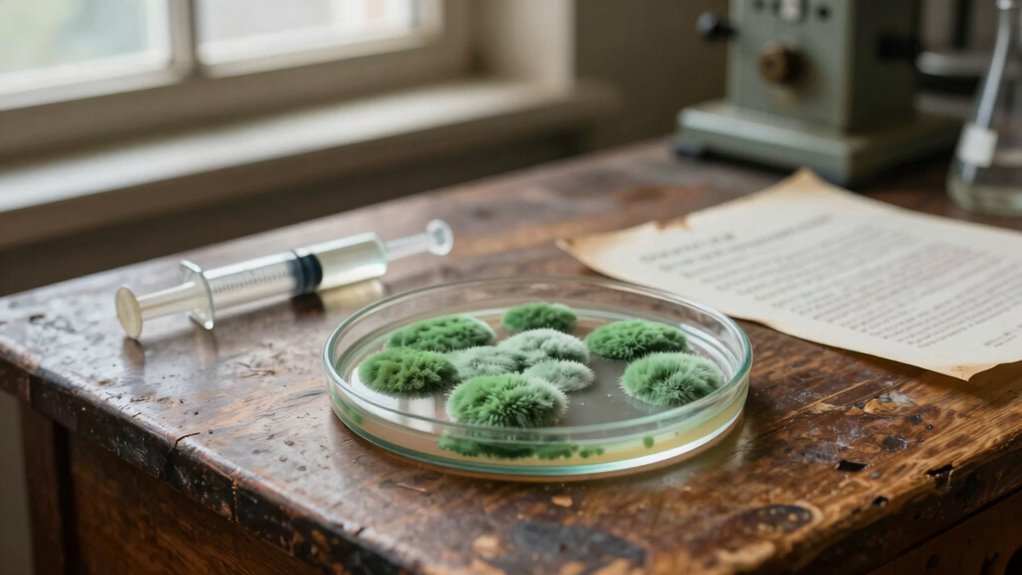

Alexander Fleming’s accidental discovery of penicillin transformed medicine by introducing the first effective antibiotic for bacterial infections. When mold contaminated his petri dish, Fleming noticed it killed bacteria around it, turning what seemed like a mishap into a breakthrough. His curiosity and careful observation led to isolating the mold’s antibacterial properties, saving millions of lives. If you explore further, you’ll discover how this serendipitous find reshaped medical treatment forever.

Get art and craft supplies delivered free — and shop member deals
- Fast, free delivery on millions of items
- Access to Prime Big Deal Days deals on October 6–7
- Prime Video, Amazon Music and more included
Key Takeaways
- Fleming’s accidental mold contamination in 1928 led to the discovery of penicillin, the first effective antibiotic.
- His observation transformed bacterial infection treatment, drastically reducing death rates from diseases like pneumonia and syphilis.
- The discovery highlighted the importance of curiosity, observation, and persistence in scientific breakthroughs.
- Penicillin’s development spurred worldwide antibiotic research, revolutionizing modern medicine and disease management.
- Fleming’s serendipitous discovery saved millions of lives and laid the foundation for the antibiotic era.

Have you ever wondered how a simple accident in a laboratory led to one of the most groundbreaking medical discoveries in history? It all begins with Alexander Fleming’s accidental discovery of penicillin, a breakthrough that revolutionized medicine forever. Fleming’s moment of serendipity changed the course of microbial research and paved the way for antibiotic development, saving countless lives. You might not realize how essential this discovery was, but Fleming’s keen observations and curiosity transformed a overlooked mold into a powerful weapon against bacterial infections.
Before Fleming’s breakthrough, treating bacterial infections was often a matter of luck or grim prognosis. Diseases like pneumonia, syphilis, and strep throat frequently resulted in death or severe complications. Fleming’s discovery proved that microbial research could lead to tangible solutions, encouraging scientists to explore microorganisms with fresh eyes. His work demonstrated that microbes could be both harmful and beneficial, opening the door to antibiotics that target bacteria without harming the human host. This realization spurred decades of research aimed at developing effective antibiotics, turning Fleming’s accidental find into a cornerstone of modern medicine. The discovery also highlighted the importance of scientific curiosity and careful observation in making breakthrough findings.
You should appreciate how Fleming’s attention to detail and scientific curiosity played critical roles in antibiotic development. When Fleming noticed that a mold called Penicillium notatum had contaminated one of his petri dishes and was killing bacteria around it, he didn’t dismiss it as mere contamination. Instead, he recognized its potential. Fleming’s meticulous microbial research allowed him to isolate the mold’s antibacterial properties, leading to the first antibiotic—penicillin. This discovery shifted the paradigm of infectious disease treatment, illustrating the profound impact of keen observation and scientific persistence. His discovery also underscored the importance of serendipity and openness to unexpected results in scientific progress. Moreover, Fleming’s work demonstrated that microbial research could lead to transformative medical breakthroughs, inspiring future generations of scientists.
The ripple effects of Fleming’s discovery extend beyond just antibiotics. It sparked a wave of microbial research worldwide, prompting scientists to search for other microorganisms and compounds that could combat bacteria. Today, antibiotics are a staple in medicine, used to treat a vast array of infections. Electric bikes and bike generators demonstrate how innovative energy solutions can be integrated into various fields, much like how Fleming’s discovery opened new pathways in medicine. Without Fleming’s chance discovery, modern medicine might still be struggling against bacterial pathogens that are resistant or untreatable. His work underscores the importance of curiosity-driven research, where accidents and unexpected findings can lead to life-saving innovations. Additionally, the development of antibiotics has significantly influenced contemporary approaches to disease prevention and treatment, emphasizing the critical role of microbial research.
antibiotic medication for bacterial infections
As an affiliate, we earn on qualifying purchases.
As an affiliate, we earn on qualifying purchases.
Frequently Asked Questions
What Inspired Fleming to Study Bacteria and Mold?
You’re inspired by Fleming’s microbial fascination and his curiosity about bacteria and mold. His interest grew from noticing how certain mold prevented bacterial growth, sparking his desire to understand microbes better. You see how his fascination led him to explore the antibacterial properties of mold, ultimately revolutionizing medicine. His microbial inspiration and fascination with mold drove him to make discoveries that saved millions of lives, highlighting the importance of curiosity and observation in science.
How Did Fleming’s Background Influence His Discovery?
They say “every cloud has a silver lining,” and Fleming’s background shaped his discovery. His personal motivations, rooted in his medical training and wartime experiences, drove him to understand bacteria better. The historical context of antibiotics’ urgent need pushed him further. His upbringing in a humble family and curiosity about science created a foundation that led to his chance discovery, ultimately saving millions.
Were There Any Immediate Consequences After the Discovery?
You notice that immediately after Fleming’s discovery, the medical world begins to change quickly. The antibiotic penicillin revolutionizes treatments, but it also sparks concerns about antibiotic resistance. Doctors start using antibiotics more frequently, leading to medical breakthroughs in fighting infections. However, these early successes also prompt cautious debate about overuse, emphasizing the need for responsible use to prevent resistance. The discovery’s impact is profound, shaping modern medicine’s future.
What Challenges Did Fleming Face in Developing Penicillin?
You face monumental challenges developing penicillin, as antibiotic resistance threatens its effectiveness, and medical ethics demand cautious testing. Fleming wrestled with limited production techniques, risking contamination, and skepticism from the scientific community. It felt like trying to tame a wild beast. Despite these hurdles, he persevered, knowing that overcoming these obstacles was essential for transforming medicine and saving millions of lives, even when ethical and resistance issues loomed large.
How Has Penicillin Impacted Modern Medicine?
You’ve seen how penicillin revolutionized medicine by effectively treating bacterial infections, drastically reducing death rates. Its widespread use led to significant medical advancements, saving millions of lives. However, you also face the challenge of antibiotic resistance, which threatens the effectiveness of penicillin and other antibiotics. This ongoing issue underscores the importance of responsible use and continued research to maintain the benefits of antibiotics in modern healthcare.
As an affiliate, we earn on qualifying purchases.
Conclusion
You can’t help but marvel at how a simple accident changed history, turning a forgotten mold into a life-saving miracle. Fleming’s chance discovery reminds you that sometimes, luck and observation intertwine in unexpected ways, shaping the future when you least expect it. It’s a demonstration to how a moment of serendipity, combined with curiosity, can lead to breakthroughs that save millions—proof that even the smallest coincidence can have the greatest impact.
microbial research lab equipment
As an affiliate, we earn on qualifying purchases.
As an affiliate, we earn on qualifying purchases.
As an affiliate, we earn on qualifying purchases.
Fall Picks
fall essentials
As an affiliate, we earn on qualifying purchases.