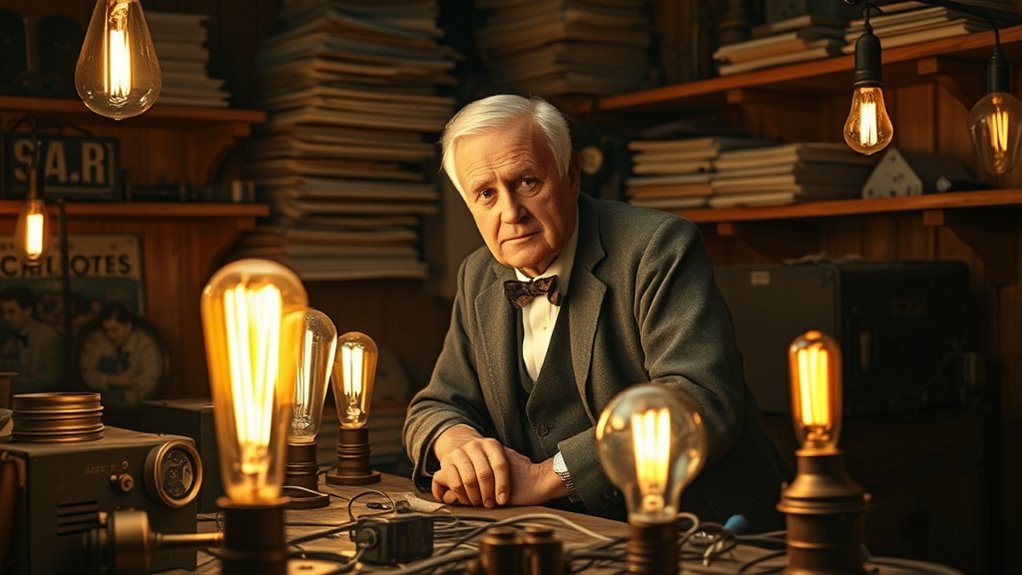

Thomas Edison revolutionized the world by inventing the electric light bulb, which transformed how you illuminate homes, streets, and workplaces, making life safer and more efficient. He also pioneered the phonograph, allowing you to record and listen to sound, music, and speeches. His innovations laid the foundation for electrical power systems and modern entertainment. If you want to discover how his inventions shaped everyday life and sparked new technologies, there’s more to explore.
Key Takeaways
- Thomas Edison developed the incandescent light bulb, revolutionizing electric lighting and enabling safer, longer-lasting illumination.
- He pioneered the phonograph, making sound recording and playback possible for entertainment and communication.
- Edison recognized the importance of reliable electrical power systems, supporting widespread electric lighting and technological advancement.
- His innovations created infrastructure that promoted societal progress, cleaner energy use, and modern electrical systems.
- Edison’s curiosity and experimentation left a lasting legacy as a transformative inventor shaping modern electricity and sound technology.

Have you ever wondered how modern life is illuminated and entertained? The answer lies in the groundbreaking work of Thomas Edison, whose inventions transformed the way we see and hear the world around us. Edison’s innovations in electricity generation laid the foundation for lighting homes, streets, and workplaces, making daily life safer and more productive. Before his contributions, people relied on gas lamps or candles, which were inefficient and dangerous. Edison’s development of the incandescent light bulb revolutionized illumination, providing a reliable and affordable source of light that extended productive hours beyond sunset. His relentless experimentation and ingenuity turned a simple idea into a practical device that changed society forever.
But Edison’s influence didn’t stop at light. He also pioneered the phonograph development, a device that could record and reproduce sound. Imagine being able to listen to music or speeches whenever you wanted—that was a reality thanks to Edison’s work. The phonograph opened a new world of entertainment and communication, making it possible to capture audio and share it across distances. This invention was not just about entertainment; it also had profound implications for education, business, and culture. You could now listen to a lecture or a song in your own home, bringing the power of sound into everyday life. Edison’s mastery in combining electrical principles with mechanical innovation led to the creation of this device, which became a cornerstone for future audio technology.
Edison’s work in electricity generation was vital for powering his inventions and, ultimately, entire cities. He recognized early on that reliable electrical power could liberate countless possibilities for society. His development of electrical systems allowed for the widespread adoption of electric lighting and paved the way for innovations in communication and entertainment. It wasn’t just about inventing devices; Edison understood the importance of creating a holistic infrastructure to support them. His vision helped shift society from reliance on gas and oil to a cleaner, more efficient electric system. Additionally, his pioneering work demonstrated the importance of technological innovation in societal progress.
All these advancements stem from Edison’s unwavering curiosity and dedication. He saw potential where others saw limitations, and through trial and error, he refined his ideas into practical solutions. Today, we live in a world illuminated by his light and filled with sound made possible by his inventions. His work continues to influence how we generate electricity, develop new technologies, and enjoy entertainment. Thanks to Thomas Edison, the modern world is brighter, louder, and more connected—a testament to what one inventive mind can achieve.

dalattin 24 Pack LED Bulbs Daylight White 5000K, 60 Watt Equivalent A19 Standard Bulbs, E26 Base, 800 LM, Efficient 9W Energy Saving, Non-Dimmable, 80+ CRI, 120V, UL Listed, for Living Room, Office
【Efficiency Meets Comfort】 Dalattin's A19 engergy saving LED bulbs replace 60W incandescents with just 9W while delivering full…
As an affiliate, we earn on qualifying purchases.
As an affiliate, we earn on qualifying purchases.
Frequently Asked Questions
Did Edison Invent the First Electric Light Bulb?
You might think Edison invented the first electric light bulb, but it was actually an incandescent innovation built on earlier work. Edison improved upon existing ideas, creating a more practical and long-lasting design. His patent disputes with other inventors highlight how competition spurred progress. Edison’s contributions revolutionized lighting, making electric bulbs accessible to everyone, even if he didn’t invent the very first one.
How Did Edison’s Inventions Impact Modern Entertainment?
You’re welcome! Edison’s inventions revolutionized modern entertainment by shaping the film industry and sparking musical innovation. Thanks to his early phonographs and motion picture experiments, you get to enjoy movies and music today. Without his groundbreaking work, your favorite films might still be silent, and your playlists less vibrant. So, next time you binge-watch or jam out, tip your hat to Edison’s brilliant, if sometimes overhyped, contributions.
What Were Edison’s Biggest Challenges During His Experiments?
During his experiments, you’d face significant challenges like experimental setbacks that slowed progress and financial struggles that threatened to halt your work. Edison often encountered technical failures and unpredictable results, requiring persistent adjustments. Additionally, securing funding was tough, especially when experiments didn’t yield immediate results. Despite these obstacles, your perseverance and innovative spirit helped you overcome setbacks, leading to groundbreaking inventions that changed the world.
Did Edison Work Alone or With a Team?
You should know that Edison didn’t work alone; he relied heavily on collaborative efforts within his innovation team. He believed that teamwork accelerated invention, so he assembled skilled assistants and collaborators to share ideas and troubleshoot problems. This collaborative approach helped him develop groundbreaking technologies like the electric light and phonograph more efficiently. Edison’s leadership and team effort made it possible to achieve innovations that changed the world.
What Was Edison’s Stance on Patents and Competition?
You might be surprised to learn Edison believed strongly in protecting his inventions through patents, even amidst intense patent disputes. He saw patents as essential for safeguarding his work and maintaining a competitive edge, often engaging in strategic battles to defend his inventions. Edison’s stance was that competition fueled innovation, but he also emphasized the importance of securing his ideas to ensure his laboratory’s success and legacy in technological progress.

KNIGHT ELECTRONICS 128GB Audio Recorder 1600 Hour Capacity, 3-Day Battery Life, Crystal-Clear Sound, Portable Digital Voice Recorder and MP3 Player Grabadora de Voz Recording Device Tape Recorder
TRUSTED BRAND: Knight Electronics is an American company that gives a 5-year limited warranty for every recorder. Got…
As an affiliate, we earn on qualifying purchases.
As an affiliate, we earn on qualifying purchases.
Conclusion
You witness Edison’s relentless innovation, his passion igniting the world’s brightest ideas. You see him transforming darkness into dawn, silence into song, and simple ideas into revolutionary inventions. You feel the spark of creativity, the power of perseverance, and the thrill of discovery. You realize that through his vision, he didn’t just invent light and sound; he illuminated our lives, awakened our senses, and inspired endless possibilities. His legacy continues to shine, echoing through every moment of progress.

Vinyl Record Player with Speakers Vintage Turntable for Vinyls Records Belt-Driven Turn Table Support 3-Speed, Wireless Playback, Headphone, AUX-in, RCA Line LP Phonograph for Sound Enjoyment Black
VINTAGE LOOKING&GREAT IDEA OPTIONS – As a music player combined age and modern sense, A vintage and fashion…
As an affiliate, we earn on qualifying purchases.
As an affiliate, we earn on qualifying purchases.

Globe Electric 59354 Payton 4-Light Track Lighting, Matte Black
MINIMALIST DESIGN: the contemporary line of the track bar pairs with the exposed socket construction and is finished…
As an affiliate, we earn on qualifying purchases.
As an affiliate, we earn on qualifying purchases.