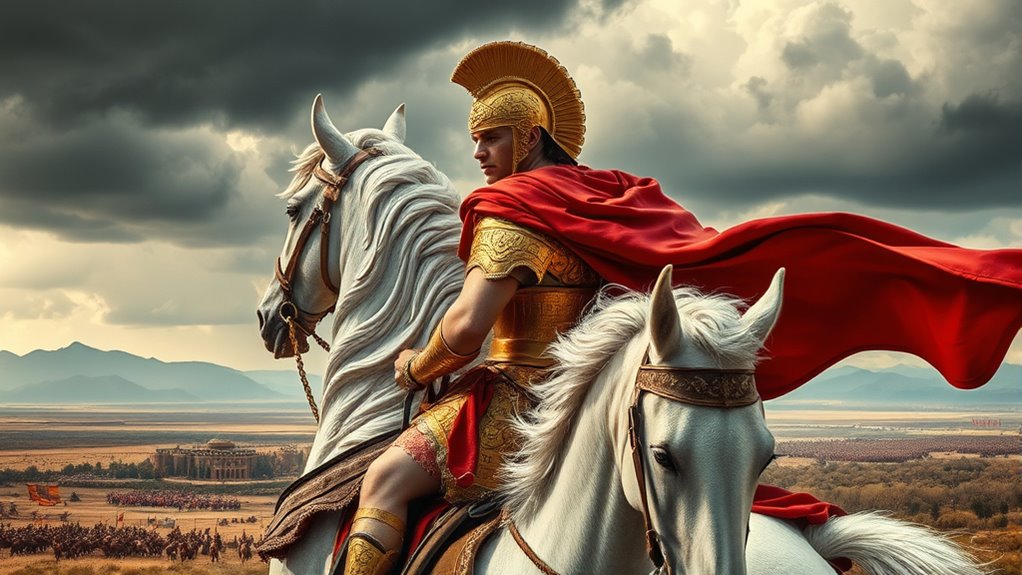

Alexander the Great transformed warfare with innovative strategies that combined speed, flexibility, and psychological tactics. You’ll see how he adapted to diverse terrains and enemies, using cavalry to outflank opponents and executing complex maneuvers in unfamiliar lands. His conquests spread Greek culture across Persia, Egypt, and India, blending traditions and creating lasting influence. If you explore further, you’ll uncover the full extent of his military genius and cultural legacy shaping history today.
Key Takeaways
- Alexander employed innovative military strategies combining speed, flexibility, and psychological tactics to defeat larger armies.
- He successfully conquered Persia, Egypt, and parts of India with well-led, smaller forces, adapting to diverse terrains.
- His campaigns facilitated cultural exchange, spreading Greek language, art, and ideas across Persia and into India.
- Alexander founded cities like Alexandria, becoming centers of learning and blending Greek and local traditions.
- His legacy endures through military studies, cultural influence, and the unification of diverse peoples under a shared civilization.

Have you ever wondered how one man could conquer an empire that stretched from Greece to India? Alexander the Great’s extraordinary achievements weren’t just about brute force; they were rooted in his innovative military strategies and his ability to spread cultural influence across vast regions. His campaigns transformed the ancient world, and understanding how he achieved such dominance gives you insight into his genius.
From the outset, Alexander displayed remarkable military prowess. He devised strategies that combined speed, flexibility, and psychological warfare. Instead of relying solely on traditional phalanx tactics, he adapted to different terrains and enemies, often surprising his foes. His use of the cavalry to outflank opponents and his ability to motivate his troops kept his armies agile and effective. These military strategies weren’t just about winning battles—they were about shaping the course of history. His tactical brilliance allowed him to conquer Persia, Egypt, and parts of India, often defeating much larger armies with smaller, well-led forces. You can see his mastery in how he executed complex maneuvers in unfamiliar territories, turning setbacks into opportunities and always staying several steps ahead of his enemies.
Alexander’s tactical brilliance combined speed, flexibility, and psychological warfare to conquer vast territories and shape history.
But Alexander’s influence extended far beyond the battlefield. His conquests facilitated a tremendous cultural exchange, known as Hellenization. As he moved through Persia and into India, he spread Greek language, art, architecture, and ideas, blending them with local traditions. This cultural influence created a fusion that endured long after his death. Cities he founded, like Alexandria in Egypt, became vibrant centers of learning, commerce, and culture. You might not realize it, but the spread of Greek thought and practices shaped the development of science, philosophy, and governance in regions that once seemed distant and disconnected from Greece. Through this blending, Alexander fostered a shared cultural identity that transcended borders, influencing civilizations for centuries. Moreover, his ability to adapt military tactics to diverse environments exemplifies military innovation, which remains a key study in strategic planning today.
His ability to combine military innovation with cultural diplomacy set him apart from other conquerors. You see, he didn’t just want to control territory; he aimed to unify diverse peoples under a new cultural framework. His empire’s reach and influence weren’t limited to the physical conquest; they extended into the realm of ideas and traditions. This dual approach—military mastery paired with cultural integration—made Alexander the Great a legendary figure whose legacy endures today. His strategies continue to be studied in military academies, and his cultural influence remains evident in art, language, and governance across continents, proving that his impact went well beyond the battlefield.

Rondauno Boning Knife, Deboning Knife 6 inch Razor Sharp Semi-Stiff Blade for Meat Cutting, High Carbon Stainless Steel Blades with Ergonomic Non-Slip Handle
Ultra Razor-Sharp: Designed for precision, this boning knife makes meat and fish preparation smooth and effortless
As an affiliate, we earn on qualifying purchases.
Frequently Asked Questions
What Was Alexander’s Childhood Like?
Your childhood upbringing was marked by a privileged education, where you learned from top tutors like Aristotle. From a young age, you were encouraged to be ambitious and brave, shaping your leadership skills early on. You were exposed to military training and Greek culture, which fueled your desire for greatness. Your early education emphasized strategy, philosophy, and bravery, laying the foundation for your future conquests and legendary status.
How Did Alexander Die?
You learn that Alexander died from a mysterious illness, likely in Babylon, after a series of feverish days. His death sparked funeral customs like grand processions and elaborate burials befitting a king. Some believe he was poisoned, but most think it was a natural illness. His body was prepared for a majestic funeral, and his death remains one of history’s enduring mysteries, leaving many questions about what truly caused it.
What Was Alexander’s Relationship With His Soldiers?
Some scholars suggest Alexander’s leadership style fostered genuine military loyalty, making his soldiers fiercely devoted. You see, he led by example and shared hardships, which built strong bonds. This close relationship meant they trusted his vision and followed him into unknown territories. His ability to inspire loyalty wasn’t just about commands, but about connecting with his troops’ ambitions and fears, creating a bond that persisted throughout his campaigns.
Did Alexander Have Any Children?
You’ll find that Alexander had no surviving legitimate children to secure royal succession. Although he had a son with Roxanne named Alexander IV, he was born after Alexander’s death and was too young to influence the succession. His offspring could have played a vital role in royal succession, but their influence was limited, leading to a power vacuum and eventual conflicts among his generals.
How Did Alexander’s Empire Influence Later Civilizations?
You might think Alexander’s empire was just a fleeting conquest, but it actually shaped civilizations through his cultural legacy and military innovations. Ironically, his relentless expansion spread Hellenistic culture far and wide, blending it with local traditions. These influences fueled future empires, inspiring military tactics and cultural exchanges that still echo today. So, your modern world owes a lot to his empire’s unexpected, lasting impact on civilization’s evolution.

Cutluxe Carving Knife Set for BBQ & Brisket – Razor Sharp German Steel Slicing and Boning Knife for Meat Cutting, Full Tang & Ergonomic Handle, Grilling Gifts for Men – Artisan Series
PREMIUM PERFORMANCE: This BBQ knife set includes a 12" brisket slicing knife and a 6" boning knife, designed...
As an affiliate, we earn on qualifying purchases.
Conclusion
As you stand at the edge of history’s vast ocean, Alexander’s journey reminds you that even in the face of storms, your courage can be your ship, and your dreams, the compass. His conquests are like a mighty river carving new paths through unfamiliar land, showing you that with boldness and vision, you can shape your world. So, set sail with confidence; your own adventure awaits beyond the horizon.

Cutluxe Butcher Knife – 10″ Cimeter Breaking Knife, Razor Sharp Forged High Carbon German Steel, Full Tang Meat Carving Knife, Ergonomic Handle Design, Grilling Gifts for Men – Artisan Series
PREMIUM PERFORMANCE – Perfectly engineered carving butcher knife tapered to a razor-sharp edge for effortless breaking down, trimming,...
As an affiliate, we earn on qualifying purchases.

Naitesen 4PCS Hand Forged Butcher Knife and Kitchen Knife 2 in 1 Set, Heavy Duty Meat Cleaver Serbian Chef Knife Breaking Knife Boning Knife for Meat Cutting BBQ Gifts for Men Women
Knife Set: Include 8.5 inch heavy duty meat cleaver, Chopping bones or butcher large animals into smaller portions,...
As an affiliate, we earn on qualifying purchases.