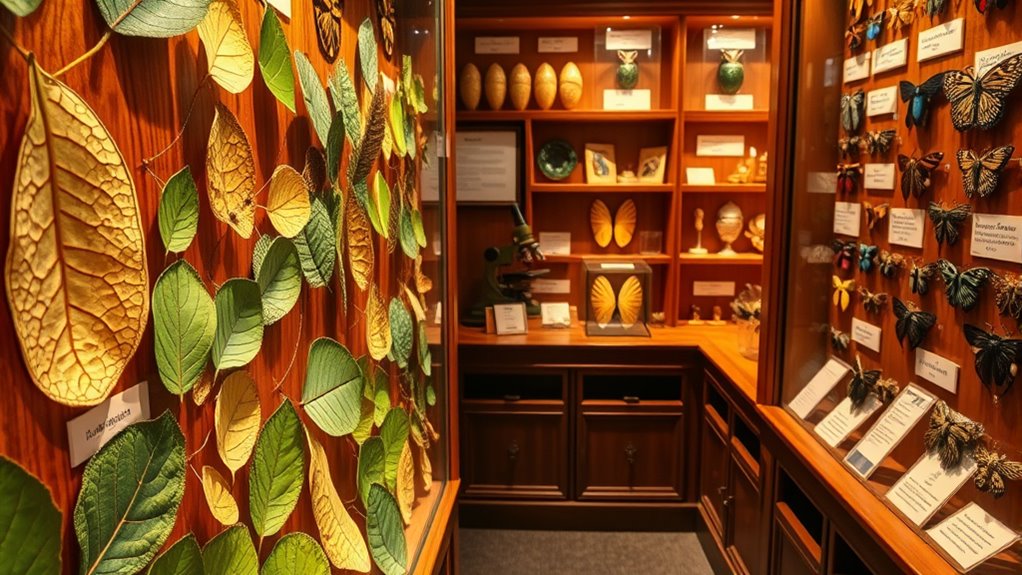

Carl Linnaeus transformed how you classify all life on Earth by developing a systematic way to organize and name species. His binomial nomenclature gives each organism a two-part Latin name, making it easier to communicate globally. His hierarchical system groups plants and animals into categories like kingdom, class, and genus, revealing their relationships. Keep exploring to discover how his methods still influence biology and help scientists understand life’s diversity today.

Get art and craft supplies delivered free with Prime
- Fast, free delivery on millions of items
- Prime Video, Amazon Music and more included
- Member-only deals all year
Key Takeaways
- Carl Linnaeus developed the binomial nomenclature system, assigning two-part Latin names to all living organisms.
- He organized life forms into hierarchical categories like kingdom, class, order, family, genus, and species.
- His classification system standardized naming, reducing confusion and facilitating global scientific communication.
- Linnaeus’s principles laid the foundation for modern taxonomy, influencing the classification of plants, animals, and all life forms.
- His work continues to underpin biological classification, aiding research, conservation, and understanding of biodiversity.

Carl Linnaeus revolutionized biology by developing a systematic way to organize and name living organisms. His approach transformed how scientists categorized the vast diversity of life, making it easier to identify and communicate about different species. Central to his system was plant taxonomy, the branch of biology dedicated to classifying and naming plants. Before Linnaeus, plant names varied widely by region and language, leading to confusion and duplication. He introduced a standardized method that assigned each plant a unique name, streamlining the study and discussion of plant life across the globe.
Linnaeus’s system simplified plant classification, creating a universal language for botanists worldwide.
Linnaeus’s most significant contribution was the creation of binomial nomenclature. This system assigns every species a two-part Latin name, consisting of the genus and species. For example, the common sunflower is called Helianthus annuus. The first part, Helianthus, identifies the broader group of related plants, while the second, annuus, specifies the particular species. This method clarified communication, ensuring everyone referred to the same organism with the same precise name. It replaced the confusing array of descriptive names that varied regionally or historically.
When you look at plant taxonomy through Linnaeus’s lens, you’ll notice how it simplifies the complex web of plant relationships. With a clear hierarchy, plants are grouped into categories such as kingdom, class, order, family, genus, and species. This structure helps you understand evolutionary relationships, trace lineage, and study plant diversity systematically. Linnaeus’s system also allows you to identify plants quickly and accurately, whether you’re in a botanical garden or studying a new discovery in the field. Additionally, his system laid the groundwork for modern taxonomy, which continues to develop with ongoing scientific discoveries.
His influence extends beyond plants. Linnaeus applied his classification principles to animals and eventually to all forms of life, creating a universal language for biology. His binomial nomenclature is still in use today, underpinning modern taxonomy and systematics. It provides a consistent framework that scientists worldwide rely on for research, conservation, and education. As you explore the natural world, you can appreciate how Linnaeus’s systematic approach offers clarity and order to the intricate web of life, making biology accessible and comprehensible across cultures and languages. His work laid the foundation for contemporary taxonomy, ensuring that the naming and classification of life continue to evolve with scientific discovery.
As an affiliate, we earn on qualifying purchases.
Frequently Asked Questions
How Did Linnaeus Choose the Names for Species?
You learn that Linnaeus chose species names based on binomial nomenclature, giving each organism a two-part Latin name. He followed strict naming conventions, using descriptive words related to the organism’s appearance, habitat, or behavior. This system made naming consistent and universal. By selecting clear, meaningful names, Linnaeus made it easier for scientists worldwide to identify and communicate about different species accurately.
Are Linnaeus’s Classifications Still Used Today?
You’ll be interested to know that Linnaeus’s classifications still influence biology today. His system of genus naming and species hierarchy laid the foundation for modern taxonomy, with over 1.7 million species now cataloged. While scientists have refined his methods, his binomial nomenclature remains the standard for naming organisms, making it easier to identify and study species across the globe. His work truly set the stage for biological classification.
How Did Linnaeus Influence Modern Taxonomy?
You’re influenced by Linnaeus’s work through his naming conventions and binomial system, which set the foundation for modern taxonomy. His method of giving each species a two-part Latin name makes classification clear and universal. Today, scientists still use his principles to organize and identify organisms, ensuring consistency across the biological sciences. His innovative approach revolutionized how we understand and communicate about the diversity of life on Earth.
What Challenges Did Linnaeus Face in Classifying Life?
Think of Linnaeus as a pioneer exploring a dense forest of life. You’d face challenges like inconsistent naming conventions and limited technology, making it hard to classify species accurately. Without advanced tools, he relied on physical traits, which sometimes led to confusion. These obstacles slowed progress but also pushed him to refine his system, establishing a foundation for modern taxonomy that’s still used today.
Did Linnaeus Classify All Living Organisms?
You might wonder if Linnaeus classified all living organisms. He didn’t, but he created a groundbreaking classification system that revolutionized species naming. His system organized life into categories like genus and species, making it easier to identify and study organisms. While he didn’t classify every single species, his work laid the foundation for modern taxonomy, helping scientists systematically understand the diversity of life on Earth.
As an affiliate, we earn on qualifying purchases.
Conclusion
So, imagine for a moment how Carl Linnaeus, with just his mind and a few tools, managed to organize all life on Earth—creating a system so perfect, it’s like he mapped out every creature’s secret code. His work is the backbone of biology, holding the universe of species together like an unbreakable chain. Without him, understanding life would be like trying to read a jumbled, chaotic puzzle—impossible and overwhelming.
scientific classification poster
As an affiliate, we earn on qualifying purchases.
As an affiliate, we earn on qualifying purchases.
As an affiliate, we earn on qualifying purchases.
Halloween Picks
halloween
As an affiliate, we earn on qualifying purchases.