You see how Cleopatra combined Egyptian divine symbols with Roman influences to assert her authority. She used hieroglyphic emblems and iconography to legitimize her reign, while blending Roman motifs to adapt to changing political pressures. Her strategic use of symbols helped her connect with both her Egyptian subjects and Roman allies, shaping her lasting myth. Continuing explores how she mastered political power through a sophisticated mix of tradition and influence.
Key Takeaways
- Cleopatra used hieroglyphic symbols and iconography to legitimize her divine authority and connect with Egypt’s royal and religious traditions.
- She strategically blended Egyptian and Roman symbols to project power and adapt to shifting political landscapes.
- Her alliances with Roman leaders Julius Caesar and Mark Antony were crucial to maintaining her throne amid expanding Roman influence.
- Cleopatra’s visual language, combining divine imagery with Roman motifs, reinforced her legitimacy and political resilience.
- Her legacy was shaped by her ability to symbolize power across cultures, ensuring her prominence in both Egyptian and Roman histories.
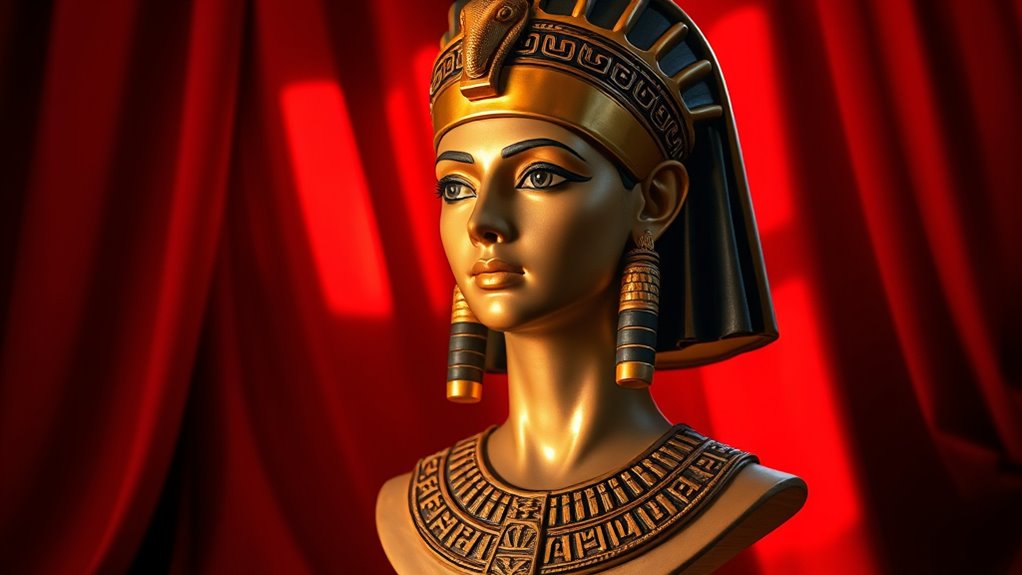
Cleopatra VII remains one of the most fascinating and complex figures of ancient Egypt, embodying a blend of power, politics, and myth that continues to captivate historians and the public alike. Her reign was marked by a mastery of symbols and narratives that reinforced her authority. One way Cleopatra communicated her divine right was through hieroglyphic symbolism, which was deeply embedded in her public image. She understood the power of visual language—emblems, titles, and iconography that connected her to the gods and her royal lineage. For example, she often portrayed herself with the uraeus serpent, symbolizing protection and sovereignty, and was depicted seated on the throne, emphasizing her status as a ruler chosen by the gods. These hieroglyphic symbols weren’t just decorative; they served as powerful tools to legitimize her rule and connect her to Egypt’s divine traditions, especially important as her reign coincided with increasing Roman influence. Additionally, her strategic use of hieroglyphic symbolism demonstrated her awareness of the importance of visual communication in reinforcing her authority.
As Rome expanded its reach, Cleopatra’s political strategy involved carefully steering through this new power dynamic. She recognized the importance of aligning herself with Rome’s emerging dominance, using her political acumen to forge alliances with influential Roman leaders like Julius Caesar and Mark Antony. Roman influence was evident in the way her rule adapted to the changing landscape—she adopted some Roman customs and political practices, blending her Egyptian heritage with the new imperial culture. This integration was not superficial; Cleopatra wielded her knowledge of Roman politics to maintain her throne, understanding that Rome’s power could be both a threat and an opportunity. She used her relationships with Roman leaders as leverage, symbolizing her as a diplomatic and strategic figure rather than merely a traditional monarch.
Her use of hieroglyphic symbolism also evolved under Roman influence. She incorporated Roman motifs into her public representations, blending Egyptian divine imagery with symbols that resonated with Roman authorities. This strategic fusion helped her project strength both to her Egyptian subjects and to her Roman allies. Cleopatra’s image as a divine queen was thus reinforced through a sophisticated understanding of symbolism that transcended cultural boundaries. She knew that her legacy depended on the ability to adapt, to symbolize her power in ways that resonated across different worlds—Egyptian tradition and Roman empire alike. Through this seamless integration of hieroglyphic symbolism and political savvy, Cleopatra crafted an identity that was both rooted in her ancient heritage and flexible enough to survive the sweeping changes brought by Roman influence.
Frequently Asked Questions
What Was Cleopatra’s Daily Life Like as Queen?
Your daily life as queen revolves around managing court life and overseeing state affairs. You attend court routines, meet with advisors, and make decisions on politics and diplomacy. Mornings might include rituals or ceremonies, while afternoons are spent reviewing documents, hosting courtiers, or engaging in strategic discussions. Despite the busy schedule, you also find time for personal pursuits, maintaining the image of strength and grace essential to your role as Cleopatra.
How Did Cleopatra Influence Egyptian Religion and Culture?
Imagine Cleopatra as a radiant sunbeam piercing through Egypt’s sky, shaping its culture and beliefs. You see her influence through religious reforms that blend Egyptian traditions with Hellenistic elements, reinforcing her divine status. Her actions elevate cultural symbolism, making her a living goddess in people’s minds. By doing so, she solidifies her power and unites her people under a shared spiritual identity, ensuring her legacy endures through the ages.
What Were Cleopatra’s Relationships With Other Roman Leaders?
You see, Cleopatra’s relationships with Roman leaders were shaped by complex Roman alliances and political rivalries. She allied with Julius Caesar, strengthening her power, but faced rivalry from Pompey and others. Her alliance with Mark Antony was strategic, yet it deepened Roman political tensions. These relationships were vital in maintaining her influence, but they also drew Egypt into the tumult of Roman power struggles, ultimately impacting her reign and legacy.
Did Cleopatra Have Children, and What Became of Them?
You learn that Cleopatra had children, particularly her son Caesarion and her daughters, Cleopatra Selene and others. These children played roles in royal succession, symbolizing her maternal legacy. Caesarion was declared co-ruler but was eventually killed, ending her direct line. Her daughters married into Roman families, carrying her influence and legacy forward, although her direct maternal line faded after her death, impacting Egypt’s royal succession and her lasting legacy.
How Accurate Are Modern Depictions of Cleopatra in Media?
Imagine watching a movie where Cleopatra is portrayed as a glamorous seductress; it’s visually mesmerizing but not entirely historically accurate. Media portrayals often emphasize her beauty and drama, overshadowing her intelligence and political skill. While they capture her charisma, they tend to exaggerate or distort facts. So, you should take these depictions with a grain of salt, understanding that they’re more entertainment than precise historical accuracy.
Conclusion
You now see Cleopatra as more than a history icon—she’s a master of power, politics, and myth. Like a savvy CEO maneuvering a modern corporate world, she used charm and strategy to shape her destiny. Her story reminds you that even in ancient times, leadership required wit and resilience. So, next time you face a challenge, channel Cleopatra’s bold spirit—because history proves that a little Cleopatra can inspire big change, even today.