
Leonardo da Vinci was a master artist, scientist, and inventor who embodies the Renaissance spirit of curiosity and innovation. You’ll find his legendary paintings like the Mona Lisa, renowned for her mysterious smile, alongside revolutionary sketches of anatomy and machines. His notebooks blend art and science, revealing a mind enthusiastic to explore every detail of the natural world. Discover how his creativity and discoveries continue to inspire centuries later if you keep exploring his extraordinary legacy.
Open a free Amazon Business account
Business pricing, bulk buying and tax-exempt orders.
As an affiliate, we earn on qualifying purchases.
Key Takeaways
- Leonardo da Vinci was a master artist famous for the Mona Lisa and his use of sfumato technique.
- He studied anatomy and created detailed sketches like the Vitruvian Man, blending art with science.
- His notebooks contain sketches, diagrams, and ideas, showcasing his holistic approach to knowledge.
- Da Vinci designed inventions such as flying machines and armored vehicles, demonstrating visionary innovation.
- He epitomizes the Renaissance polymath, integrating art, science, and engineering to advance multiple disciplines.
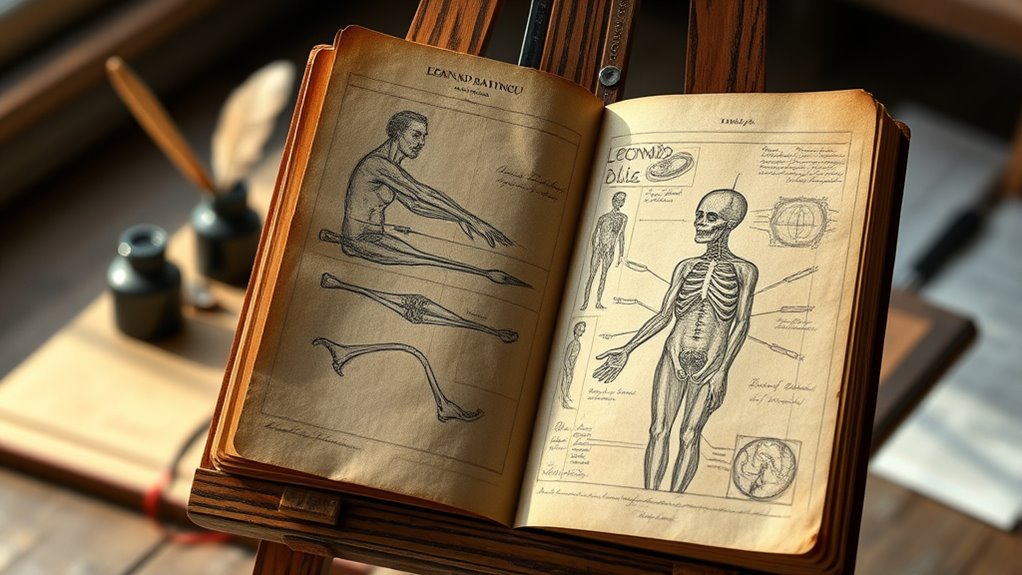
Have you ever wondered what makes Leonardo da Vinci one of the most remarkable figures of the Renaissance? It’s his extraordinary ability to blend art, science, and innovation that sets him apart. Think about the Mona Lisa, with her mysterious smile that captivates viewers around the world. This masterpiece exemplifies Leonardo’s mastery of techniques like sfumato, creating a realistic depth and subtlety that still fascinate centuries later. But Leonardo’s genius wasn’t limited to painting; he was also fascinated by human anatomy and proportion, which led him to study the Vitruvian Man. This iconic drawing is more than just a sketch; it’s a symbol of the Renaissance ideal of harmony between art and science. It demonstrates his keen understanding of human proportions, showing how the human body can be perfectly inscribed within a circle and square. When you look at the Vitruvian Man, you see Leonardo’s obsession with precision and his desire to understand the underlying principles of nature.
Leonardo’s curiosity knew no bounds. He kept notebooks filled with sketches, scientific diagrams, engineering ideas, and anatomical studies. His approach was holistic—he believed that art and science were interconnected, and he used his artistic eye to observe the world with incredible detail. This is why his anatomical drawings, based on dissections he performed himself, remain some of the most accurate ever created. You can imagine him meticulously measuring and recording every detail, seeking to understand the mechanics of the human body. His sketches reveal a mind constantly questioning and exploring, zealous to uncover how things work beneath the surface.
His work on inventions, from flying machines to armored vehicles, shows his inventive spirit. Leonardo was ahead of his time, dreaming of innovations that wouldn’t be realized until centuries later. Yet, despite his many pursuits, he never lost his focus on capturing the beauty and complexity of the human form and the natural world. When you study his art and sketches, you see a person driven by curiosity and a relentless pursuit of knowledge. Whether he’s painting a portrait or studying anatomy, Leonardo da Vinci exemplifies the Renaissance ideal of a true polymath—someone who combines creativity, scientific inquiry, and boundless imagination to push the boundaries of what’s possible.
Leonardo da Vinci Mona Lisa replica
As an affiliate, we earn on qualifying purchases.
As an affiliate, we earn on qualifying purchases.
Frequently Asked Questions
What Inspired Leonardo’s Diverse Range of Inventions?
You’re inspired by Leonardo’s diverse inventions because he constantly observed biological phenomena and combined them with artistic experimentation. His curiosity about how nature works fuels his innovative ideas, leading him to explore new engineering concepts. By blending scientific inquiry with creative expression, you see how his keen eye for biological details and artistic skills spark ideas that push the boundaries of technology and art alike.
Did Leonardo Ever Complete All His Major Artworks?
You might think Leonardo completed all his major artworks, but many remain unfinished masterpieces. His artistic challenges, like balancing perfection with time constraints, often left works incomplete. You see, he constantly sought perfection, which slowed progress. Despite his incredible talent, some projects, like the “Adoration of the Magi,” stayed unfinished. So, while he created masterpieces, not all of his major artworks were ever fully finished.
How Did Leonardo’s Notebooks Influence Modern Science?
Your understanding of Leonardo’s notebooks shows how they influenced modern science by shaping scientific methodology and technological innovation. You see how his detailed sketches, observations, and experiments laid the groundwork for systematic inquiry and experimentation. His approach encouraged future scientists to question, observe carefully, and document findings meticulously, fostering a scientific mindset. This legacy continues today, proving how Leonardo’s notebooks remain an essential bridge between art, science, and innovation.
Was Leonardo’s Work Fully Recognized During His Lifetime?
His work was like a seed planted in secret; during his lifetime, you’d find limited artistic recognition and only scattered praise from his contemporaries. While some admired his genius, many didn’t fully grasp his innovations. Leonardo’s brilliance was ahead of its time, so it wasn’t until after his death that the world truly appreciated his contributions, turning him into a legendary figure of art and science.
What Personal Qualities Made Leonardo a Visionary Thinker?
You see, Leonardo’s personal qualities like creative curiosity and relentless pursuit made him a true visionary thinker. His insatiable desire to explore new ideas pushed boundaries and fueled innovation. You notice how he constantly questioned the world around him, never settling for easy answers. This relentless pursuit of knowledge and his ability to think outside the box set him apart, making his work revolutionary even before society fully recognized his genius.
As an affiliate, we earn on qualifying purchases.
Conclusion
You can see how Leonardo’s genius still inspires us today. Imagine you’re designing a new flying machine, inspired by his sketches of flight. Just like him, your ideas could revolutionize the world. His blend of art, science, and vision shows that thinking beyond boundaries leads to greatness. So, keep exploring, creating, and dreaming—because, like Leonardo, your innovative spirit could change history.
Renaissance art sfumato technique book
As an affiliate, we earn on qualifying purchases.
As an affiliate, we earn on qualifying purchases.
As an affiliate, we earn on qualifying purchases.
Fall Picks
fall essentials
As an affiliate, we earn on qualifying purchases.