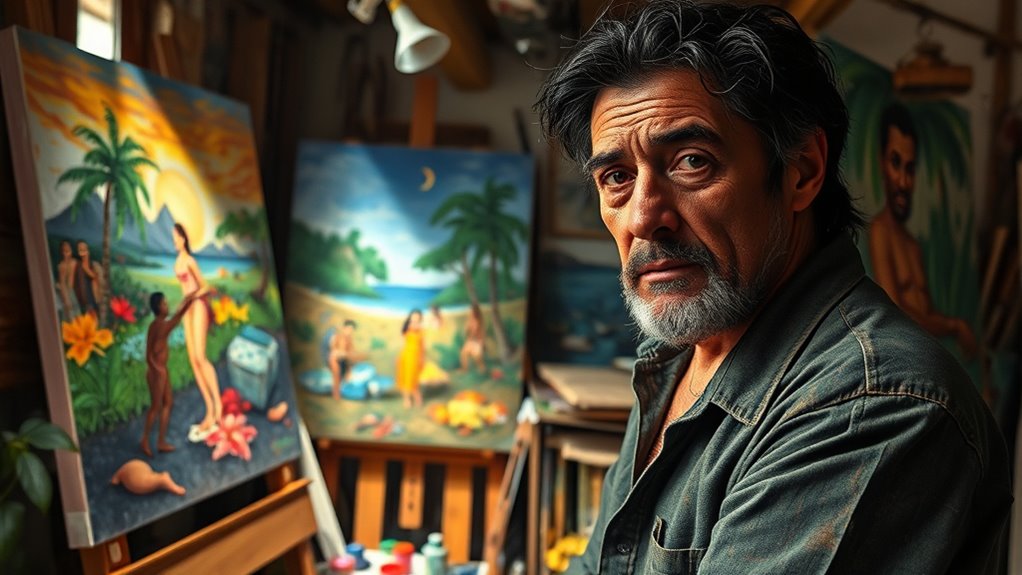

Paul Gauguin’s journey from a successful stockbroker to a radical painter transformed art forever. He broke away from traditional Impressionism, embracing bold colors, simplified forms, and symbolic styles influenced by Polynesian culture. Gauguin focused on expressing emotion and spirituality through vibrant hues and decorative techniques, creating a new visual language beyond European norms. If you want to explore how his daring shift affected art and perception, there’s more to discover ahead.
Key Takeaways
- Gauguin left his career as a successful stockbroker to pursue radical painting and artistic expression.
- He broke away from traditional Impressionism to embrace Post Impressionism techniques.
- His use of vivid colors and simplified forms aimed to evoke emotion and spirituality.
- Gauguin traveled to Tahiti, integrating Polynesian motifs and cultural themes into his art.
- His transformation challenged artistic conventions, inspiring new perceptions of art and reality.

Have you ever wondered how an artist’s bold visions can transform the way we see the world? Paul Gauguin’s journey from a successful stockbroker to a radical painter is a perfect example of daring to follow your creative instincts. When you look at his work, you’ll notice he broke away from traditional Impressionism, embracing Post Impressionism techniques to express deeper emotional and symbolic meanings. Unlike his contemporaries, Gauguin prioritized color and form over realistic representations, using vivid, unnatural hues to evoke mood and spirituality. His brushstrokes are often flat and decorative, emphasizing pattern and design rather than perspective or natural light. This approach allows you to see the world through his eyes—vibrant, symbolic, and infused with personal meaning.
Discover how Gauguin’s bold, colorful style transforms perception into vibrant, symbolic, and emotionally rich visions.
Gauguin’s fascination with Polynesian influence played a *vital* role in shaping his distinctive style. When he traveled to Tahiti and other islands, he sought a purer, more authentic way of life—one that he believed could inspire art free from European conventions. The bright, tropical landscapes and the indigenous culture profoundly affected his palette and subject matter. His paintings from this period often feature simplified forms, bold outlines, and a focus on the spiritual and mythological aspects of Polynesian life. By integrating Polynesian motifs into his work, Gauguin created a visual language that was both exotic and deeply personal. It’s as if he wanted to capture the soul of the islands, translating it onto canvas with striking color contrasts and symbolic imagery.
You might notice how Gauguin’s use of Post Impressionism techniques and Polynesian influence makes his art stand out. His approach isn’t just about aesthetic beauty; it’s about conveying emotion and spiritual truth. His color choices aren’t realistic but are deliberately chosen to evoke feelings—vibrant reds, lush greens, and deep blues that seem to pulse with life. His simplified shapes and flattened perspective challenge your expectations of naturalism, inviting you to see beyond the surface and explore deeper meanings. Additionally, his innovative use of color theory played a crucial role in heightening the emotional impact of his work, allowing viewers to experience the mood and symbolism more intensely.
Gauguin’s radical departure from traditional European art was driven by his desire to express something more profound. His use of Post Impressionism techniques, combined with his fascination for Polynesian culture, allowed him to forge a new artistic language—one that encourages you to look beyond appearances and connect with the spiritual essence of his subjects. His work invites you to see the world with fresh eyes, full of color, symbolism, and emotion, forever changing how you perceive art and reality.
Frequently Asked Questions
What Inspired Gauguin’s Shift to Radical Artistic Styles?
You’re inspired by Gauguin’s desire to break free from traditional art. He sought symbolic experimentation and embraced bold color palettes to express deeper meanings and emotions. His shift was driven by a yearning for authenticity and spiritual connection, pushing him to explore new techniques. This radical departure from realism allowed him to create vibrant, emotionally charged works that challenge viewers and evoke powerful responses.
How Did Gauguin’s Background Influence His Art Themes?
You might find it a coincidence that Gauguin’s background shaped his art themes, but it truly did. His experience as a stockbroker exposed him to diverse cultures and ideas, fueling his fascination with different societies. These cultural influences, combined with his innovative artistic techniques, led him to explore themes of primitivism and spirituality. Your understanding of his background reveals how personal history can profoundly influence artistic expression.
What Was Gauguin’s Impact on Post-Impressionism?
You see Gauguin’s impact on Post-Impressionism through his bold use of color theory and artistic innovation. His experiments with non-naturalistic colors and flat forms challenge traditional perspectives, inspiring other artists to explore emotional expression. By breaking away from realistic representation, Gauguin pushes Post-Impressionism toward abstraction, encouraging future artists to prioritize personal symbolism over realistic accuracy, ultimately shaping modern art’s evolution.
Did Gauguin Face Any Controversies During His Career?
Yes, Gauguin faced controversies during his career. You might find that his work sparked ethical dilemmas, especially around cultural appropriation, as he drew heavily from Tahitian culture. Some critics argued he exploited native traditions for personal artistic gain. His decisions to leave Europe and live among indigenous communities also fueled debates about respecting local cultures versus artistic inspiration. These controversies continue to influence discussions on ethics in art today.
How Did Gauguin’s Personal Life Affect His Artistic Choices?
You know what they say, “You are the company you keep,” and Gauguin’s personal struggles deeply influenced his artistic choices. His turbulent life, marked by personal loss and dissatisfaction, pushed him toward exploring new cultures and ideas. Cultural influences became essential, as he sought authenticity and meaning beyond European conventions. His personal life’s upheavals fueled his desire for radical, expressive art, shaping his bold, distinctive style.
Conclusion
So, here you are, thinking Gauguin’s journey was all about chasing beauty and meaning. Ironically, it was his bold departure from the safe world of stockbroking that truly defined his legacy. You might say he traded one kind of stability for chaos, yet somehow, that chaos gave us some of the most iconic art of all time. Sometimes, it’s the wildest leaps that leave the deepest mark on history.