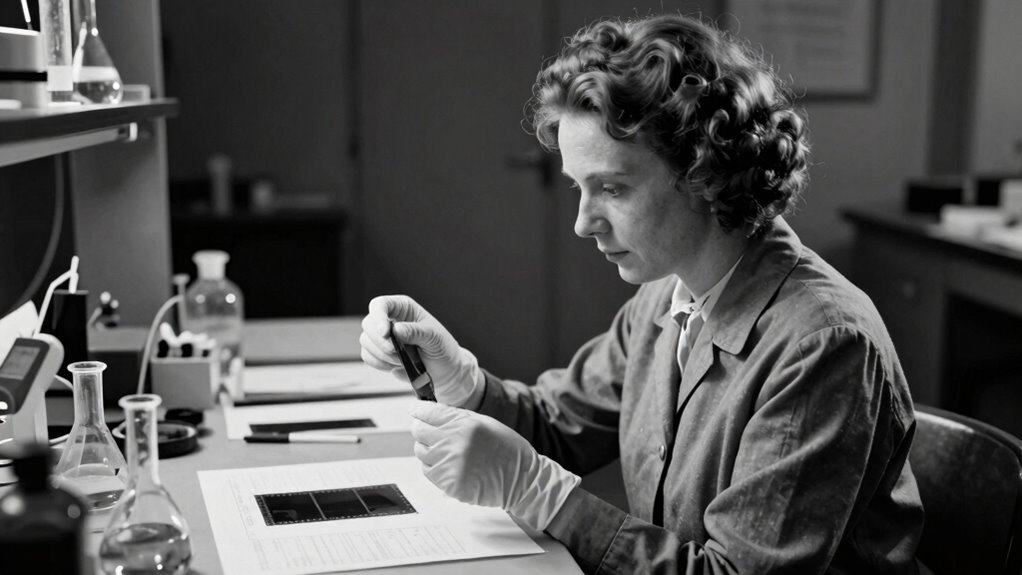

You might not realize that Rosalind Franklin played a essential role in revealing DNA’s structure, using X-ray crystallography to create the famous Photo 51. Her work was critical in confirming the double helix model, but her contributions were overlooked for years due to societal biases and scientific oversight. Recognizing her story reminds you how recognition can be delayed by biases. If you keep exploring, you’ll discover even more about her inspiring legacy and impact.

Get art and craft supplies delivered free with Prime
- Fast, free delivery on millions of items
- Prime Video, Amazon Music and more included
- Member-only deals all year
Key Takeaways
- Franklin’s X-ray images, especially Photo 51, were crucial in confirming the DNA double helix structure.
- Her contributions were initially overlooked, with Watson and Crick receiving most recognition.
- Societal gender biases delayed acknowledgment of her vital role in DNA research.
- Modern science now fully recognizes Franklin’s significant impact and legacy.
- Her story highlights the importance of fair credit and awareness of biases in scientific recognition.

Have you ever wondered why some groundbreaking scientists are only celebrated after their contributions are long overlooked? Rosalind Franklin is a prime example. Her work played a crucial role in revealing the DNA structure, yet her name wasn’t widely recognized for years. You might not realize that Franklin’s expertise with X-ray crystallography allowed her to generate some of the clearest images of DNA, including the famous Photo 51. This image became a pivotal piece of evidence leading to the discovery of the double helix, but Franklin’s contributions weren’t immediately acknowledged. Instead, her work was often overshadowed by her male colleagues, Watson and Crick, who received most of the scientific recognition for the discovery.
Rosalind Franklin’s crucial X-ray images laid the groundwork for the DNA double helix discovery, yet her contributions remained largely unrecognized.
When you look at the history of DNA research, it’s clear Franklin’s meticulous approach and scientific rigor provided essential insights. Her understanding of DNA’s structure was groundbreaking at the time, yet her contributions were initially overlooked or underappreciated by the scientific community. Many believe this was due to gender biases prevalent during that era, which prevented her from receiving the credit she deserved. Her role was vital in confirming the double helix model, but it took years for the broader scientific community to recognize her influence. Franklin’s work exemplifies how the scientific process isn’t always fair; sometimes, recognition is delayed because of societal biases or simple oversight. Recognizing scientific contributions from diverse backgrounds is essential for a more equitable understanding of history.
It’s only later that Franklin’s significance was fully appreciated, and her story became a symbol of overlooked talent and injustice in science. Her perseverance in the face of these obstacles highlights the importance of giving recognition where it’s due. Today, her name is associated with integrity, dedication, and groundbreaking research, serving as a reminder that scientific discovery often involves many unseen contributions. Her story also underscores the importance of proper acknowledgment in the scientific community, emphasizing that recognition should follow genuine contribution, not gender or reputation. Furthermore, advances in color accuracy and imaging technology have helped highlight her critical role and ensure her contributions are now properly celebrated. Her powerful legacy continues to inspire efforts to promote equity in science and ensure all voices are valued. Recognizing the significance of her work has also led to ongoing discussions about gender equality in STEM fields.
In the end, Franklin’s legacy reminds you that scientific recognition isn’t always immediate or fair. Her detailed understanding of the DNA structure, gained through her expert use of X-ray crystallography, helped shape one of the most significant discoveries in biology. Her contributions, once overlooked, now stand as a testament to the importance of giving credit to those who lay the groundwork for future breakthroughs. Franklin’s story encourages you to value every contributor’s role, regardless of their background, and to remain vigilant against biases that can delay rightful recognition.
DNA X-ray crystallography images
As an affiliate, we earn on qualifying purchases.
As an affiliate, we earn on qualifying purchases.
Frequently Asked Questions
What Specific Experiments Did Franklin Conduct That Were Pivotal?
You see, Franklin conducted vital experiments using X-ray diffraction, which revealed the DNA’s double helix structure. Her detailed photographs, like Photo 51, provided key insights into DNA analysis, showing the helical shape and dimensions. These experiments were fundamental because they laid the groundwork for understanding DNA’s structure, enabling Watson and Crick to build their famous model. Franklin’s work was indispensable, even if her contributions weren’t fully recognized at first.
How Did Franklin’s Background Influence Her Scientific Approach?
Your educational background acts as a sturdy foundation, shaping your scientific methodology like a well-tuned compass guiding a ship through stormy seas. Franklin’s rigorous training in physics and chemistry instilled precision and meticulousness, fueling her groundbreaking work. Her background symbolized resilience and curiosity, inspiring her to approach problems with unwavering focus. This blend of education and methodology drove her to uncover the DNA structure, even when recognition came too late.
Were There Any Notable Controversies Surrounding Her Contributions?
You should know that Franklin faced notable controversies due to gender bias, which affected her scientific recognition. Despite her critical contributions to DNA’s structure, her work was often overshadowed or attributed to her male colleagues. This gender bias delayed acknowledgment of her role, leading to debates about fair recognition. Her story highlights how gender bias in science can hinder deserving recognition, underscoring the need for equitable acknowledgment of all scientists’ contributions.
How Has Her Legacy Impacted Women in Science Today?
Her legacy inspires you to challenge gender bias in science and recognize the importance of diverse role models. You see Franklin’s story as a reminder that women’s contributions often go unacknowledged, motivating you to advocate for equality. Her impact encourages future generations to pursue scientific careers regardless of gender, fostering an environment where all voices are valued and recognized for their true contributions.
What Recent Discoveries Have Shed New Light on Her Work?
Recent discoveries highlight Rosalind Franklin’s vital role, challenging gender bias in science and emphasizing the importance of scientific recognition. New analyses of her X-ray diffraction images reveal her significant contribution to DNA structure, previously overshadowed. These findings push the scientific community to re-evaluate historical narratives and acknowledge her work more fully, inspiring future generations of women in science to seek recognition and challenge gender bias in their fields.
Rosalind Franklin DNA discovery book
As an affiliate, we earn on qualifying purchases.
As an affiliate, we earn on qualifying purchases.
Conclusion
You’ve seen how Rosalind Franklin’s groundbreaking work on DNA went unrecognized for too long. Did you know that her Photo 51 was essential in discovering the double helix, yet her contributions were overlooked for decades? It’s a reminder of how history sometimes delays giving credit where it’s due. As you reflect, consider how many other brilliant minds might still be waiting for recognition, urging you to value every voice in the pursuit of truth.
As an affiliate, we earn on qualifying purchases.
As an affiliate, we earn on qualifying purchases.
Fall Picks
fall essentials
As an affiliate, we earn on qualifying purchases.