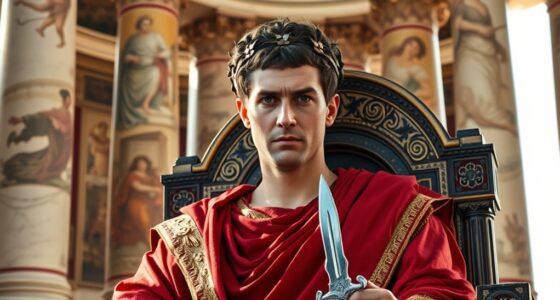
You see Socrates as a relentless questioner, challenging Athens’ norms through his Socratic method to seek ethical truth. His focus on morality and virtue made him a societal gadfly, disrupting accepted beliefs. His relentless pursuit of truth led to accusations of impiety and corrupting youth, resulting in his trial and death. If you explore further, you’ll uncover how his commitment to philosophical integrity continues to influence ideas about ethics and free inquiry today.
Key Takeaways
- Socrates dedicated his life to ethical inquiry using the Socratic method to challenge societal norms and uncover moral truths.
- His relentless questioning made him a gadfly, irritating authorities and prompting societal suspicion of his motives.
- Socrates’ focus on virtue and morality often conflicted with Athenian norms, leading to accusations of impiety and corrupting youth.
- Despite facing a death sentence, Socrates refused to abandon his philosophical pursuits, emphasizing truth and integrity.
- His trial and death cemented his legacy as a symbol of philosophical integrity and the pursuit of moral truth.

Socrates, the ancient Greek philosopher renowned for his pursuit of truth and ethical inquiry, lived during a turbulent time in Athens’ history. His life was marked by a relentless quest to understand what it means to live a virtuous life, often confronting complex ethical dilemmas that challenged the beliefs of his fellow Athenians. You might imagine yourself engaging with Socrates in the agora, where his method of questioning—known as the Socratic method—forces you to examine your assumptions and confront uncomfortable truths. His approach was not just about acquiring knowledge but about probing the very foundations of moral values, making his philosophical inquiries deeply intertwined with ethical dilemmas that pushed the boundaries of conventional thinking.
Engage with Socrates in the agora to explore moral foundations and confront ethical dilemmas through the Socratic method.
Socrates believed that true wisdom came from recognizing your own ignorance, and he used this insight to encourage others to think critically about their beliefs. When faced with ethical dilemmas, he refused to accept easy answers or dogma, instead prompting others to consider what is just, good, or right. Through his relentless questioning, you realize that many of the moral convictions held by Athenians were superficial or unexamined, and Socrates challenged them to reflect more deeply. His philosophical inquiries aimed not only to uncover universal truths but also to inspire individuals to lead more examined lives. This approach often put him at odds with those in power, who saw his questions as dangerous and disruptive to social order. Additionally, understanding the importance of contrast ratio enhances the appreciation of how clarity and depth in philosophical discourse can be metaphorically linked to visual image quality.
The core of Socrates’ method was engaging others in dialogue, forcing them to defend their beliefs and revealing contradictions in their reasoning. You might see this as a kind of moral excavation, digging beneath surface-level opinions to discover what truly underpins ethical conduct. By doing so, Socrates exposed the complexities behind moral choices and the difficulty of defining what is right in a given situation. His focus on ethics made him a gadfly to Athenian society, as he constantly challenged the accepted norms and authority figures who preferred conformity and unquestioned tradition. His commitment to philosophical inquiries into morality and virtue ultimately drew the ire of those in power, leading to his trial.
The trial of Socrates became a pivotal moment in Western philosophy, highlighting the tension between free inquiry and societal stability. You understand that his refusal to cease questioning and his dedication to ethical exploration ultimately led to his conviction for impiety and corrupting youth. Despite facing the death penalty, Socrates remained true to his principles, emphasizing that the pursuit of truth and ethical integrity was more important than his own life. His death cemented his legacy as a philosopher who dared to challenge the status quo, inspiring generations to grapple with ethical dilemmas and seek deeper philosophical inquiries into what it means to live rightly.

Philosophy 101: From Plato and Socrates to Ethics and Metaphysics, an Essential Primer on the History of Thought (Adams 101 Series)
As an affiliate, we earn on qualifying purchases.
As an affiliate, we earn on qualifying purchases.
Frequently Asked Questions
What Was Socrates’ Relationship With His Students Like?
You have a close, mentor-like relationship with Socrates’ students, as he actively engages them through his unique teaching methods. He questions them relentlessly, encouraging critical thinking and self-examination. Socrates doesn’t simply give answers; he guides his students to discover truths on their own. This interactive approach fosters deep understanding, making his mentorship memorable and impactful, shaping their philosophical outlooks and inspiring lifelong pursuit of wisdom.
Did Socrates Write Any Philosophical Texts Himself?
You’ll find that Socrates didn’t write any philosophical texts himself. Instead, his ideas live on through the Socratic dialogues, written by his students like Plato. These dialogues showcase his philosophical methodology, where he asks questions to challenge assumptions and reveal truths. By engaging in these conversations, you can explore his approach to ethics and knowledge, even without original writings from Socrates himself.
How Did Socrates Influence Later Philosophers?
Think of Socrates as the spark that ignited a fire in philosophy. You see, his questioning approach and focus on ethical dilemmas shaped how later philosophers think and teach. His pedagogical methods, like the Socratic method, encourage critical thinking and dialogue. This influence endures today, inspiring you and others to challenge assumptions, explore moral issues, and seek truth through thoughtful conversation and inquiry.
What Was Socrates’ Diet and Daily Routine?
You probably know that Socrates’s diet reflected typical Ancient dietary practices, focusing on simple, modest foods like bread, vegetables, and occasional meat. His daily routine in Athens involved engaging in dialogues, questioning others, and contemplating life’s big questions, often spending time at the Agora. Socrates prioritized philosophical pursuits over luxury, embracing a humble lifestyle that aligned with Athens’s everyday routines, emphasizing virtue and self-awareness over material wealth.
Are There Any Surviving Artifacts Related to Socrates?
Like whispers from the past, some ancient artifacts and archaeological findings related to Socrates still survive today. You can find fragments of pottery, inscriptions, and sculptures that hint at his life, though no complete relics exist. These remnants serve as silent witnesses, bridging centuries and giving you a tangible connection to the philosopher’s enduring legacy. They remind you that even in fragments, history’s voice persists.

The Socratic Method: A Practitioner's Handbook
As an affiliate, we earn on qualifying purchases.
As an affiliate, we earn on qualifying purchases.
Conclusion
So there you are, watching Socrates, the original pest with a penchant for poking holes in everyone’s ideas. His relentless questions, like a philosophical mosquito, kept the city buzzing—and itching. Maybe he was just too annoying for Athens, or maybe he simply refused to shut up. Either way, his trial proved that challenging authority isn’t always appreciated. In the end, Socrates proves that sometimes, the loudest truth-teller gets the loudest silence—yet somehow, he still endures.
The Nicomachean Ethics (Penguin Classics)
As an affiliate, we earn on qualifying purchases.
As an affiliate, we earn on qualifying purchases.

Ancient Greek Philosophers (Leather-bound Classics)
As an affiliate, we earn on qualifying purchases.
As an affiliate, we earn on qualifying purchases.