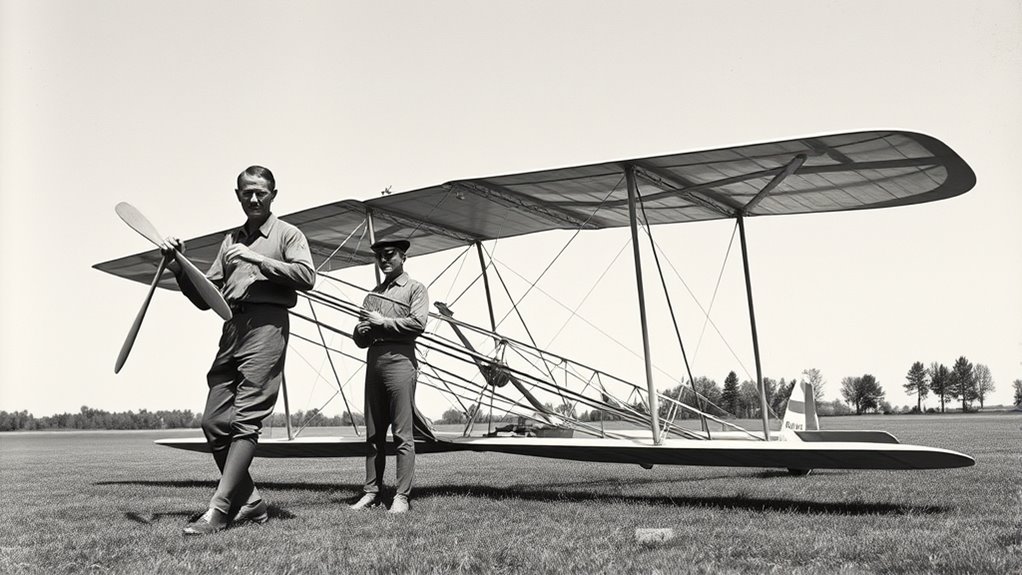

Wilbur and Orville Wright revolutionized aviation by achieving the first successful powered, controlled flight, marking a major milestone in transportation history. They focused on controlling airships and built experiments like gliders before creating the Wright Flyer, which took off at Kitty Hawk in 1903. Their innovative work on control systems and lightweight engines made sustained flight possible. If you want to learn more about how these pioneers changed the world forever, keep exploring their incredible story.
Listen free for 30 days with Audible
Thousands of audiobooks and originals — cancel anytime.
As an affiliate, we earn on qualifying purchases.
Key Takeaways
- Developed the first successful powered, controlled airplane, the Wright Flyer, on December 17, 1903.
- Invented a wing-warping system to achieve precise aircraft steering and control.
- Conducted extensive experiments with gliders to understand stability and maneuverability.
- Pioneered innovations in aerodynamics, mechanics, and engineering that revolutionized flight.
- Their achievements launched the age of powered flight and transformed transportation worldwide.
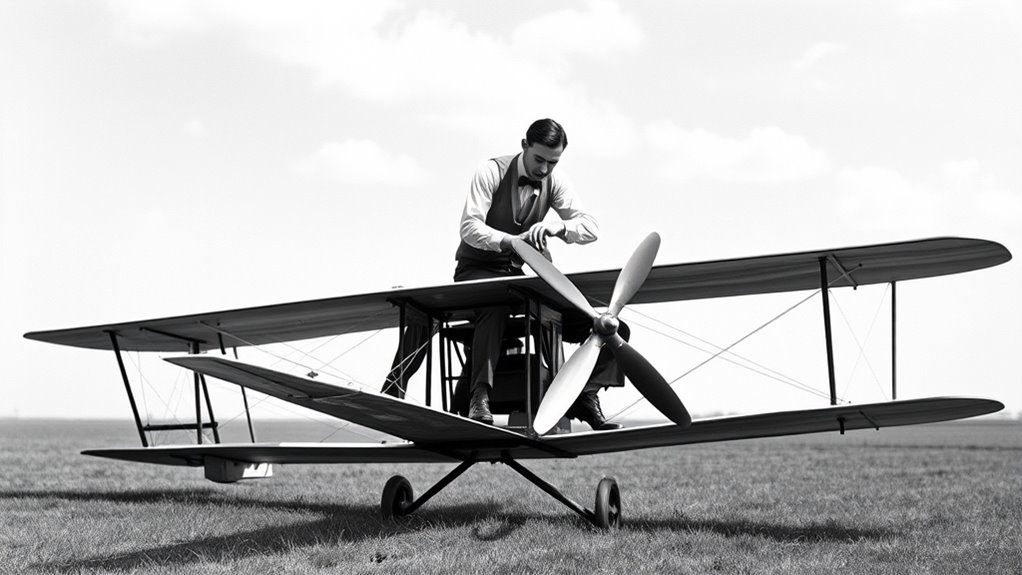
Wilbur and Orville Wright were pioneering American inventors and engineers who revolutionized transportation by developing the first successful powered airplane. Their work marked a turning point in aviation innovation, transforming human capability to fly and opening the skies to countless possibilities. You might imagine the challenge they faced—transforming dreams of flight into reality required not only ingenuity but also relentless perseverance. Their journey began with a series of early flight experiments that laid the groundwork for modern aviation. These experiments weren’t simple or straightforward; they involved countless hours of testing and refining ideas to overcome the fundamental problems of balance, lift, and propulsion.
Wilbur and Orville Wright’s perseverance and innovation launched the age of powered flight.
In their early flight experiments, the Wright brothers focused on understanding how to control a flying machine. They built gliders to test different wing shapes and control systems, learning that stability and maneuverability were critical for success. You’d see them meticulously recording data, adjusting their designs based on real-world results. Their experiments were driven by a deep curiosity and a desire to push the boundaries of what was thought possible. Through trial and error, they discovered that a lightweight engine and a carefully designed propeller could generate enough power for sustained flight. This was a major breakthrough, demonstrating that powered, controlled flight was achievable.
Aviation innovation didn’t happen overnight. The Wright brothers combined their knowledge of mechanics, aerodynamics, and engineering to create their aircraft, the Wright Flyer. They built it with a focus on control—something many earlier attempts at flight overlooked. Their innovative approach involved inventing a system of wing-warping to steer the aircraft, giving them precise control during flight. When they finally achieved their historic first flight on December 17, 1903, at Kitty Hawk, North Carolina, they proved that powered flight was not just a dream but a real possibility. The moment’s significance reverberated across the world, inspiring future generations of engineers and inventors. Their experiments with control systems contributed significantly to the development of aviation technology.
Their early flight experiments laid the foundation for a new era of transportation, transforming how humans travel and connect. Every test, every adjustment brought them closer to the dream of flying like birds. You can see their legacy in today’s airplanes, drones, and countless flying machines that continue to evolve. The Wright brothers’ dedication to aviation innovation and their perseverance through early flight experiments changed history. Their work exemplifies how curiosity, experimentation, and determination can turn a visionary idea into a groundbreaking reality.
model airplane kits for beginners
As an affiliate, we earn on qualifying purchases.
As an affiliate, we earn on qualifying purchases.
Frequently Asked Questions
What Inspired Wilbur and Orville Wright to Pursue Flight?
You’re curious about what inspired Wilbur and Orville Wright to pursue flight. Their fascination with aerospace engineering and technological innovation drove them to solve the challenge of human flight. They studied existing inventions, experimented tirelessly, and dreamed of making flying accessible. Their passion for progress and curiosity about how things work motivated them to push boundaries, ultimately leading to their groundbreaking achievement in aviation.
How Did the Wright Brothers Fund Their Experiments?
Imagine you’re building a delicate bridge, each plank carefully laid. The Wright brothers funded their experiments through a mix of funding sources and smart investment strategies. They used money from family savings, profits from their bicycle shop, and small grants. This steady, resourceful approach helped them sustain their relentless pursuit of flight, transforming their humble beginnings into a groundbreaking journey in aviation history.
What Challenges Did They Face During Early Flight Tests?
During early flight tests, you face numerous challenges, including ensuring aviation safety and overcoming test flight failures. You have to carefully analyze each crash or stall, learn from mistakes, and refine your designs. Weather conditions and limited technology also complicate progress. Persistence is key, as each failure brings you closer to successful flight. Your dedication to safety and innovation drives you through these setbacks toward achieving powered, controlled flight.
Did the Wright Brothers Have Any Aviation Rivals?
You’ll find that the Wright brothers faced notable aviation competition and technological rivalry during their time. In fact, many other inventors and pilots, like Samuel Langley, tried to beat them to powered flight. This rivalry pushed them to innovate constantly, with their 1903 Flyer marking a significant milestone—covering 120 feet in 12 seconds. Their determination helped establish their leadership, but the competitive atmosphere fueled rapid advances in early aviation technology.
How Did Their Invention Impact Aviation Industry Development?
Your invention revolutionized the aviation industry by introducing groundbreaking aviation innovations and technological advancements. It paved the way for faster, safer, and more efficient aircraft, inspiring ongoing improvements. You can see how their pioneering work sparked a global pursuit of flight, leading to commercial airlines, military aircraft, and space exploration. Their achievements set the foundation for modern aviation, transforming transportation, communication, and commerce worldwide.
As an affiliate, we earn on qualifying purchases.
Conclusion
You’ve just witnessed how Wilbur and Orville Wright turned the sky into their playground. Their determination lit a fire that ignited humanity’s dream of flight, soaring like birds breaking free from the earth’s grip. Their pioneering spirit is the wind beneath our wings, reminding us that with courage and innovation, we can reach for the impossible. So next time you look up at the sky, remember: it was their dreams that made the heavens a little closer.
As an affiliate, we earn on qualifying purchases.
As an affiliate, we earn on qualifying purchases.
Flea & tick season Picks
flea and tick prevention
As an affiliate, we earn on qualifying purchases.