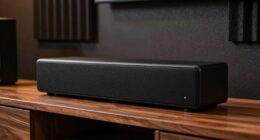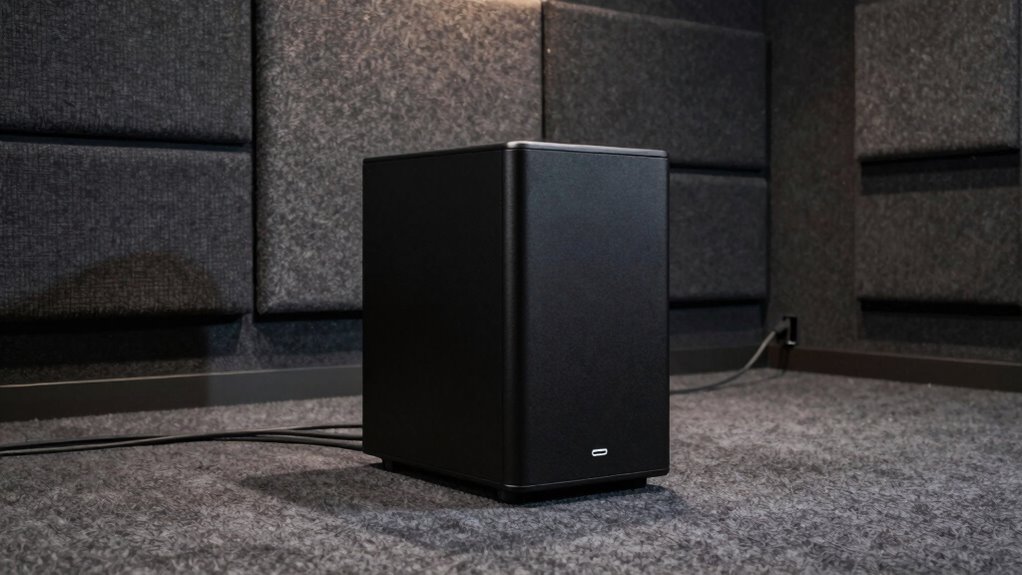

To get the best bass, start by experimenting with your subwoofer’s placement; moving it away from walls or corners can prevent boomy sounds, while near-wall positions boost bass but may cause muddiness. Use your ears to find a spot where the bass is full, tight, and even, and adjust calibration settings like volume, crossover, and phase accordingly. Proper positioning and fine-tuning are key, and if you keep exploring, you’ll discover how small changes make a big difference.
Key Takeaways
- Experiment with subwoofer placement away from walls and corners for balanced, smooth bass.
- Use calibration and fine-tuning to adjust volume, crossover, and phase for optimal sound.
- Incorporate soundproofing and vibration isolators to enhance clarity and prevent external interference.
- Listen critically to find the “sweet spot” with full, tight, and even bass response.
- Remember that trial and error in placement significantly impacts overall bass quality.
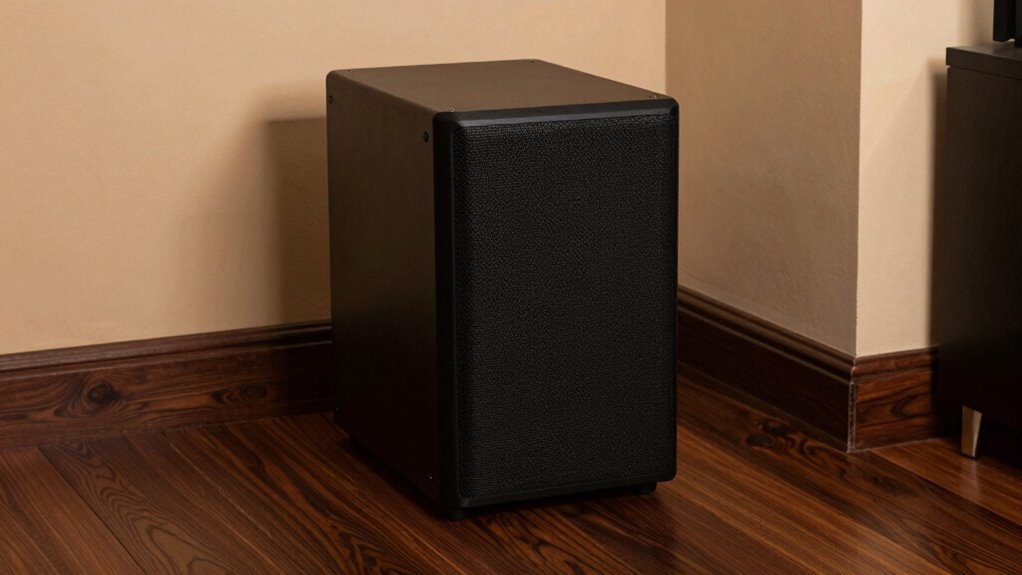
Are you wondering where to place your subwoofer for the best sound experience? The placement of your subwoofer can dramatically impact how you perceive bass and overall sound quality. To maximize your setup, start by considering how the subwoofer interacts with your room’s acoustics. Proper woofer calibration is essential, as it ensures your subwoofer produces balanced and accurate bass. This involves adjusting settings like volume, crossover frequency, and phase to match your main speakers perfectly. When you calibrate your woofer correctly, you avoid boomy or muddy bass sounds that can ruin your listening experience.
Optimizing subwoofer placement and calibration ensures balanced, accurate bass for a superior listening experience.
Next, think about your room’s layout. Subwoofers are notorious for creating standing waves and bass nulls, where certain frequencies cancel out or become overly pronounced. To mitigate this, experiment with different placements within the room. Typically, placing the subwoofer near a wall or corner amplifies bass but can sometimes cause boomy sound. Moving it away from walls or corners can help achieve a smoother, more balanced bass response. The goal is to find that sweet spot where bass sounds full, tight, and even across your listening space.
Soundproofing techniques also play a significant role in ideal subwoofer placement. If your room isn’t well-isolated, vibrations can transfer through floors and walls, causing disturbances or unwanted noise. Use soundproofing techniques such as isolating pads or stands, which absorb vibrations and prevent them from transferring outside the room. These measures help maintain clarity and prevent your bass from leaking into adjoining spaces, giving you a cleaner sound experience. Proper soundproofing also keeps external noise from interfering with your listening, making your bass sound more precise and immersive.
It’s worth noting that no single placement is universally perfect; it often takes some trial and error. Use your ears as your guide. Play familiar tracks and listen for the most balanced, punchy bass without distortion or muddiness. Adjust your woofer calibration settings after moving the subwoofer to fine-tune the sound. Remember, consistency is key—once you find the sweet spot, mark the position or remember the setup for future reference.

2-Pack for 8''- 10'' Studio Monitor Noise Isolation Pads Subwoofer Platform Speaker Riser 3-Layer Acoustic Stand Foam Stereo Vibration Isolation Stabilizer Base (15.5'' x 13'')
ENHANCES AUDIO PERFORMANCE: This sound isolation pads for speakers studio monitor and subwoofer, isolates any vibration generated from…
As an affiliate, we earn on qualifying purchases.
As an affiliate, we earn on qualifying purchases.
Frequently Asked Questions
How Can I Hide My Subwoofer Without Affecting Sound Quality?
You can hide your subwoofer without affecting sound quality by choosing an enclosure or furniture that complements your room’s acoustics and aesthetics. Select a cabinet with proper ventilation to avoid acoustic treatment issues that can muffl the sound. Alternatively, place the subwoofer behind a decorative screen or inside a furniture piece designed for sound, balancing aesthetics with acoustic performance. This way, you hide your subwoofer effectively while maintaining ideal sound quality.
Does Room Size Impact Subwoofer Placement Strategies?
Room size considerably shapes your subwoofer setup, so consider room acoustics and furniture placement carefully. Larger rooms require strategic placement to fill the space without creating boomy bass, while smaller rooms need precise positioning to avoid muddiness. Use furniture to absorb or diffuse sound waves, enhancing clarity. By balancing room dimensions and thoughtful furniture placement, you’ll optimize sound quality, making your audio experience immersive and impactful regardless of room size.
Can Multiple Subwoofers Improve Overall Sound Experience?
Using multiple subwoofers can greatly improve your overall sound experience. They help distribute subwoofer frequency more evenly across your room, reducing dead spots and uneven bass. By adjusting the subwoofer phase, you guarantee that all subs work together seamlessly, minimizing phase cancellation and enhancing bass response. This setup creates a more immersive and balanced sound, making your listening experience richer and more accurate.
What’s the Best Way to Calibrate Subwoofer Sound Levels?
You should calibrate your subwoofer by matching its frequency response to your main speakers and guaranteeing phase alignment. Use a sound level meter or receiver calibration tool for precise adjustments. Don’t worry if it seems complex—many systems have automatic calibration features. Fine-tuning the phase ensures the subwoofer integrates seamlessly, preventing sound cancellation. Proper calibration enhances clarity, bass depth, and overall sound quality, making your listening experience more immersive and enjoyable.
How Do I Prevent Rattling or Vibrations From My Subwoofer?
To prevent rattling or vibrations from your subwoofer, start by adding subwoofer insulation around the unit to absorb excess vibrations. Use vibration dampening pads or mats beneath the subwoofer to isolate it from surfaces that transmit vibrations. Tighten all mounting hardware securely, and consider placing the subwoofer on a stable, non-resonant surface. These steps effectively reduce rattling, ensuring cleaner sound and less disturbance.

KEF KSK92 Subwoofer Stacking Kit
Stack to increase maximum output and provide even better dynamics for an even more accurate performance, without sacrificing…
As an affiliate, we earn on qualifying purchases.
As an affiliate, we earn on qualifying purchases.
Conclusion
Think of your subwoofer as the heartbeat of your sound system. When placed just right, it pulses with perfect rhythm, transforming your space into a symphony of deep, rich bass. Experiment with different spots until you find that sweet spot where everything syncs seamlessly. Remember, it’s not just about where you put it — it’s about creating a musical landscape that feels alive, vibrant, and perfectly tuned to your ears. Happy listening!

Pyle Adjustable Speaker Wall Mount Brackets – 2 Pack Extendable Steel Arms for Center Channel, Small or Large Speakers & Soundbars – 110 lbs Capacity, 6.7-11.8" Depth – Includes Mounting Hardware
ADJUSTABLE BRACKET LENGTH: These Pyle shelf speakers feature adjustable and extending bracket lengths that allow for universal speaker…
As an affiliate, we earn on qualifying purchases.
As an affiliate, we earn on qualifying purchases.

Speaker Absorbing Polyester Fiber, 100x50x5CM Polyester Fiber Speaker Soundproofing Foam, Interior Insulation, Subwoofer Damping HiFi Speakers DIY Repair Replacement
Premium Polyester Fiber Material for Safe & Effective Sound Absorption: This sound absorber is made of high-quality polyester…
As an affiliate, we earn on qualifying purchases.
As an affiliate, we earn on qualifying purchases.