
Get art and craft supplies delivered free with Prime
- Fast, free delivery on millions of items
- Prime Video, Amazon Music and more included
- Member-only deals all year
Stillness as the main event
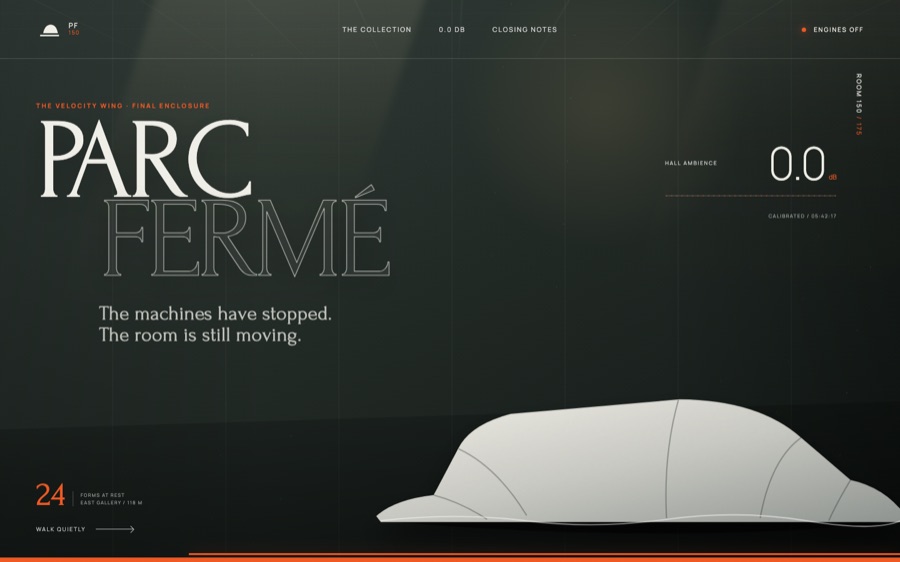
Parc Fermé — The Museum of Speed is an AI-built exhibition room imagined for a fictional speed museum. It serves as an after-hours coda to a gallery of racing machines: twenty-four vehicles stand in a dawn-lit hall, hidden beneath pale covers. The signature move is simple and theatrical. Lift one corner of a sheet, and a flash of the machine’s orange body appears beneath it. The room turns restraint into spectacle: instead of showing speed in motion, it asks visitors to recognize it at rest.
The silence is part of the display, too. A fixed instrument reads 0.0 decibels, giving quiet the form of a museum object rather than leaving it as an absence. The room’s premise is that velocity becomes legible when nothing moves.
Products Worth Considering

GoPro Wireless Mic Complete Kit with 2 Transmitters, 2 Receivers, and Charging Case

Garmin Striker Vivid 7cv Fishfinder with GT20-TM Transducer

Garmin vívoactive 5 GPS Smartwatch, 42mm, Black
As an affiliate, we earn on qualifying purchases.
How the room earns its hush
A limited material vocabulary
Cold concrete grey and warm, dust-sheet white dominate the scene, supported by dark ink for readable text. Signal orange is carefully rationed to plinth edges, room numbers, and moments of interaction. A softer gold belongs to the dawn light. This small palette makes the orange reveal feel consequential: it is not decoration scattered across the page, but a glimpse of the energy the covers conceal.
Typography reinforces the contrast between artifact and explanation. An inscriptional display face lends titles a carved, archival quality; Manrope keeps labels, measurements, and prose clear and contemporary. Tight uppercase lettering makes the small metadata feel calibrated, like markings on a technical instrument.
One lift, many silhouettes
Each of the twenty-four exhibits has its own SVG silhouette, shaped to preserve what makes that machine recognizable: the low teardrop of a streamliner, the upright stance of a rocket, or the distinctive outline of a bicycle. Each drawing has its own gradient and clipping identifiers, so repeated SVG structures do not accidentally share effects.
The sheet itself is divided into a central cloth shape and a clipped corner. On hover, keyboard focus, or tap, only that corner lifts to uncover the orange form below; the rest of the cover stays in place. The object’s placard follows on a slower easing curve, giving the reveal a measured, physical rhythm instead of making the whole exhibit pop open at once. Touch interaction updates the expanded state, tapping elsewhere closes it, and Escape provides a keyboard exit.
Light with a light touch
Atmosphere comes from code rather than generated images: HTML, CSS, SVG, and a restrained canvas dust effect. Dust particles drift through the beams, with their work capped and paused when the page is hidden. An inspection button sends a beam across the hall and resolves the covered machines in sequence as shadows. Scroll progress gently warms the essay’s light, while the decibel display remains intentionally fixed. Reduced-motion settings replace animated flourishes with a static presentation.

From prompt to finished room
The work follows a three-pass pipeline: build the exhibition from its core idea of a silent dawn hall; apply a merciless critique to strip away anything that competes with the silhouettes and controlled reveal; then seek art-director certification for the final balance of craft, atmosphere, and usability. The room’s Keeper’s Field Guide makes that process inspectable, documenting its visual tokens, interaction details, motion choices, and implementation functions rather than treating the finished page as magic.
The full build notes live in the room’s design guide.
Want this? Paste this into your AI coding agent
Build a single-page showcase website from this art-direction brief. Work like an elite creative frontend engineer; commit totally to the direction.
BRIEF (room 150 of 175, “parcferme”):
PARC FERMÉ — the museum of speed: Wing VI’s finale and epilogue. Aesthetic: cold morning hall; machines asleep under dust sheets. Palette: hall grey, dust-sheet white, one signal-orange plinth line, dawn gold through skylights. Fonts: forum (lapidary), manrope (placards). SIGNATURE: ENGINES OFF — all 24 Wing VI machines parked in one long hall under dust sheets (SVG silhouettes beneath draped cloth — you recognize each room by shape alone: the streamliner’s teardrop, the fan disc, the foiling hull); HOVER lifts a sheet corner for a glimpse and a placard (each linking to its room). A decibel meter reads 0.0 dB — the wing that screamed, measured in silence. The closing essay: speed only exists against stillness; records are kept by clocks that do not move. Dawn slowly gilds the skylights as you reach the end. Unforgettable: recognizing 24 rooms by their shapes under cloth.STACK: pure HTML/CSS/JS, no build step, no frameworks, no CDNs or external requests of any kind; self-hosted fonts only; every visual is code (CSS/SVG/canvas/WebGL) — no image assets required.
QUALITY BAR: flawless at 390px, 834px and 1440px with zero horizontal overflow; tap targets >= 44px; semantic landmarks, focus-visible styles, body-text contrast >= 4.5:1; prefers-reduced-motion pauses or simplifies heavy animation; rAF loops pause when the tab is hidden; hold 60fps (cap particle counts, avoid layout thrash); rich invented content everywhere — real-sounding names, numbers and program notes, never lorem ipsum; orchestrate one beautiful staggered load moment plus scroll and hover surprises. FORBIDDEN: Inter/Roboto/Arial/system-ui, purple-gradient-on-white, and cookie-cutter hero+cards+footer layouts.
PROCESS: iterate in three documented passes — (1) build plus builder self-critique, (2) merciless external critique finding and fixing at least ten real problems, (3) art-director elevation from good to unforgettable. Screenshot at all three widths every pass and fix everything you can see.
— Original brief by Claude Fable 5 (art director), executed by the FABLE/175 pipeline.
— This room lives at https://fable-25-830.netlify.app/sites/parcferme/
This is the verbatim art-direction brief that produced the room — exposed by the exhibition itself via the “Prompt” link in the room’s footer.
Step inside the silence
Visit the live Parc Fermé room to explore its covered collection and quiet inspection pass. Parc Fermé is a fictional, AI-built exhibition piece—not a real museum or company. To see the wider project, browse all 175 rooms at the hub.
Visit the live room → · Browse all 175 rooms
Previously in Wing VI
- Room 138: APEXWERK — The Grip Curriculum
- Room 127: Meridian 843 | The Measured Mile
- Room 136: Courier — Spoke & Signal
FABLE / 175 is a finished exhibition of 175 fundamentally different websites, each built end-to-end by an AI. This article is part of our series walking through it room by room.