TL;DR
Radiant Geometries: Vectors of Knowledge from the Indigenous Americas is on view at Rice University’s Moody Center for the Arts in Houston through Dec. 19. Curated by Noor Alé, the exhibition brings together contemporary Indigenous artists whose work engages with ancestral and technological knowledge through textiles, sculpture, painting, video and sound. The source report does not provide attendance figures or further exhibition programming details.
Rice University’s Moody Center for the Arts is presenting Radiant Geometries: Vectors of Knowledge from the Indigenous Americas, a group exhibition exploring how contemporary Indigenous artists draw on ancestral and technological knowledge. The show spans artists and cultural traditions across North, Central and South America and is scheduled to remain on view in Houston through Dec. 19.

Get art and craft supplies delivered free with Prime
- Fast, free delivery on millions of items
- Prime Video, Amazon Music and more included
- Member-only deals all year
Curated by Noor Alé, the exhibition brings together painting, sculpture, textiles, video and sound. According to the exhibition description reported by Colossal, the works consider mathematical, metaphysical, social and environmental ideas, as well as relationships among nature, narrative and innovation. The artists’ distinct cultural backgrounds inform their approaches; the show is not limited to a single medium or one regional tradition.
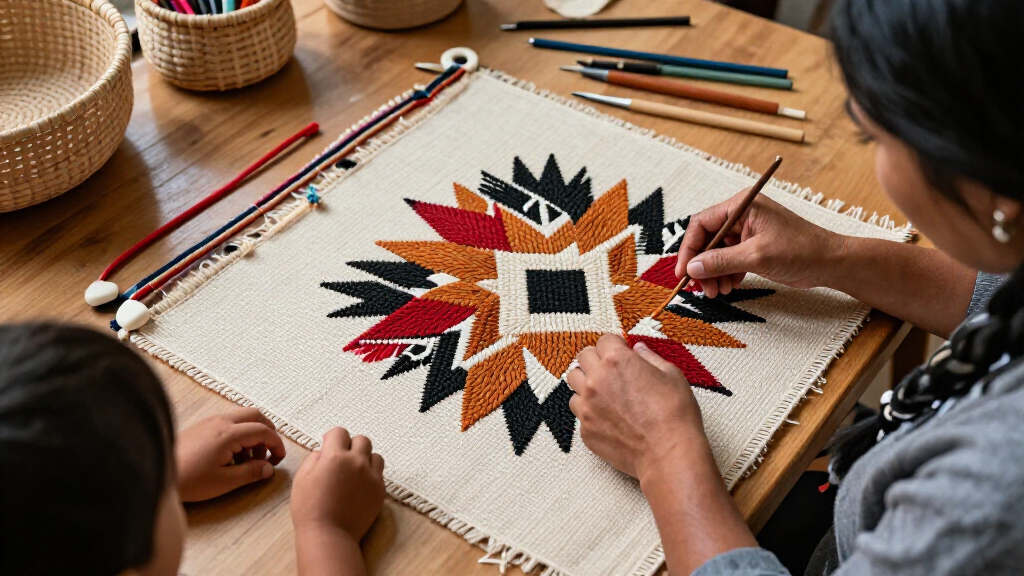
Melissa Cody, a Navajo/Diné artist, draws on generations of weaving knowledge. She works with both a traditional vertical Navajo loom and a mechanized Jacquard machine, combining established patterns and motifs with contemporary designs and messages. Her 2025 textile Sunrise Rainbows uses Jacquard weaving and aniline-dyed wool fringe, linking handwoven practice with machine-assisted production.
Other featured works include geometric abstractions by Eamon Ore-Giron, informed by Indigenous motifs and symbols as well as hard-edge painting, and Tótems de emergencia by Aymara artist Natalia Montoya Lecaros. The latter comprises four upright, mixed-media sculptures arranged in a circle. The exhibition also includes artists such as Patricia Domínguez, Jordan Ann Craig, Nanibah Chacon, Patrick Martinez and Caroline Monnet.
Indigenous Knowledge in Contemporary Art
The exhibition places Indigenous systems of knowledge at the center of a contemporary art presentation, rather than treating them only as historical reference. Its focus on mathematics, science and architecture connects creative practice with ways of understanding land, waterways, living beings and community. The works also make visible how artists adapt inherited methods through present-day materials and technologies.
That relationship is especially clear in Cody’s use of both a body-powered loom and a Jacquard machine. Ore-Giron’s paintings bring Indigenous symbols into conversation with modern geometric abstraction, while Montoya Lecaros’s installation reworks visual elements associated with Aymara clothing. These are distinct artistic approaches, not evidence of a single shared Indigenous worldview; the exhibition’s breadth makes those differences part of its subject.
Products Worth Considering

Garmin VIRB 360 Waterproof 360-Degree Camera, 5.7K/30fps

Coleman Snap 'N Go Collapsible Hard Cooler (45 Quart)

Coleman Classic Series 100-Quart Insulated Wheeled Cooler
As an affiliate, we earn on qualifying purchases.
From Ancestral Practice to New Media
The exhibition’s source material points to long histories behind some of the practices and references on view. Diné weaving uses upright looms and patterned textiles; Navajo-Churro sheep, whose wool is used in some weaving traditions, were introduced to the region by Spaniards in the 16th century. In Mesoamerica, Maya artists made ceramics with natural motifs, including birds, more than a thousand years ago.
Those examples provide context, but the show is focused on present-day artists and their interpretations, not a survey of historical objects. Cody’s machine-woven work and Ore-Giron’s engagement with both Indigenous imagery and 20th-century abstraction illustrate how contemporary practices can draw on multiple sources. The museum’s listing also notes a separate large-scale vinyl installation by Sharmistha Ray, set to open Oct. 22 and remain on view through Jan. 29; it is not identified as part of Radiant Geometries.
“At its core, Radiant Geometries centers Indigenous ways of knowing that continue to shape relationships to territories, waterways, and interspecies care.”
— Noor Alé, curator of Radiant Geometries
Details Beyond the Exhibition Listing
The available report confirms the venue, curator, participating artists and scheduled closing date, but does not give attendance figures, ticketing information, public-program schedules or details about whether the exhibition’s run could change. It also does not describe every work in the show or provide artist statements for all participants. Readers should not assume that every artwork addresses the same themes or represents all Indigenous communities across the Americas.
Houston Exhibition Runs Through December
Radiant Geometries is scheduled to remain on view at the Moody Center for the Arts through Dec. 19, 2026. The source report directs readers to the center’s website for its exhibition listings; further details about visiting and related events should be checked there. Separately, Sharmistha Ray’s vinyl installation is scheduled to open Oct. 22 and continue through Jan. 29.
Key Questions
Where is Radiant Geometries on view?
The exhibition is at Rice University’s Moody Center for the Arts in Houston.
When does the exhibition close?
It is scheduled to remain on view through Dec. 19, 2026.
Who curated Radiant Geometries?
Noor Alé curated the exhibition.
What kinds of work are included?
The exhibition includes textiles, painting, sculpture, video and sound, with works by artists including Melissa Cody, Eamon Ore-Giron, Natalia Montoya Lecaros and Nanibah Chacon.
Is Sharmistha Ray’s installation part of the exhibition?
The report lists Ray’s vinyl installation separately. It is scheduled to open Oct. 22 and remain on view through Jan. 29.
Source: rss