
TL;DR

Get art and craft supplies delivered free with Prime
- Fast, free delivery on millions of items
- Prime Video, Amazon Music and more included
- Member-only deals all year
A first-instance court ordered the Rodin Museum and France’s Culture Ministry to provide 3D scans of Auguste Rodin sculptures in December 2023, but the claimant says they did not comply. He has now appealed a separate ruling that allowed point-cloud files to be withheld; the source report describes the Conseil d’État’s handling of the case but does not provide the final ruling’s date or full operative details.
France’s Conseil d’État has ruled in an eight-year dispute over public access to 3D scans of Auguste Rodin sculptures, according to a report by claimant Cosmo Wenman, but the material provided does not state the verdict date or reproduce the court’s complete ruling. The case concerns whether files held by the Rodin Museum count as administrative documents that must be disclosed under French freedom-of-information law.
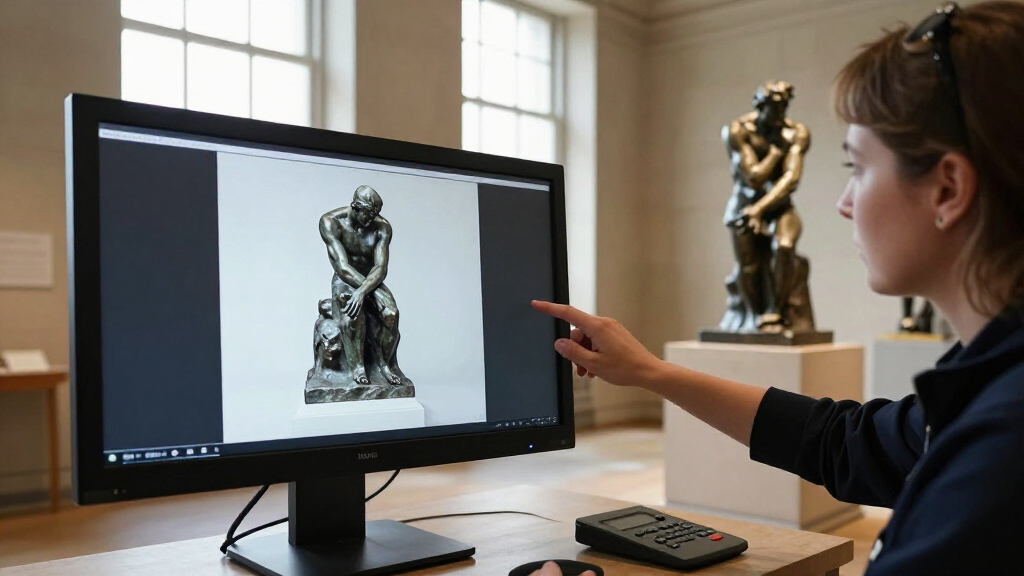
The dispute began in 2017, when Wenman sought identification and public access to scans of works including Le Penseur, Le Baiser and La Porte de l’Enfer. Wenman says the museum resisted disclosure and argued in court that some files were difficult to use, incomplete or subject to legal exceptions. Those characterizations are allegations in his account, not independently established findings in the material provided.
In December 2023, the Paris Administrative Tribunal ruled that scans in a range of formats were administrative documents and ordered the museum and Culture Ministry to provide them to Wenman. The court also ordered €1,500 in compensation, according to the source report. Wenman says the institutions did not comply and did not appeal that order. The supplied account does not include the judgment or independent confirmation of the institutions’ response.
The appeal at the Conseil d’État focused on the treatment of point-cloud files, a type of 3D scan data. Wenman says the court accepted a basis for withholding some such files, despite their storage in open, plain-text formats. He challenges the court’s reasoning and describes it as an exception without a discernible legal basis. The source material does not provide the full verdict, so the precise scope of the ruling and its legal rationale cannot be independently assessed here.
Access to Publicly Held Scan Files
The case tests how French freedom-of-information rules apply to digital records created or held by a public cultural institution. Its outcome could affect whether museums must disclose digitized heritage materials, and whether the technical format of a file can limit public access even when the underlying work is in the public domain.
For researchers, educators and digital heritage groups, access to detailed scans can support study, preservation and reuse. At the same time, the dispute involves questions about file usability, possible commercial interests and restrictions claimed by the museum. The available account does not establish how the Conseil d’État balanced those concerns or whether its decision applies beyond the files in this case.
Products Worth Considering

Therabody SmartGoggles 2nd Gen Heated Eye and Temple Massager

GoPro MAX2 Waterproof 360 and Traditional Action Camera with Touch Screen

GoPro HERO Compact Waterproof 4K Action Camera
As an affiliate, we earn on qualifying purchases.
How the Dispute Reached Appeal
Wenman says he sought the scans beginning in 2017. After Paris-based civil-rights advocate Alexis Fitzjean Ó Cobhthaigh submitted a formal request, France’s Commission on Access to Administrative Documents, or CADA, issued an opinion supporting disclosure, according to the report. CADA’s opinion is advisory; the supplied material does not include its text.
Wenman, Fitzjean Ó Cobhthaigh and the organizations Communia, Wikimédia France and La Quadrature du Net brought a case before the Paris Administrative Tribunal in 2019. The tribunal’s December 2023 judgment partly favored disclosure but, as Wenman describes it, treated point-cloud files differently. The plaintiffs appealed that aspect to the Conseil d’État. The source report is written from the claimant’s perspective and does not include a response from the museum or ministry.
“The scans were “unquestionably administrative documents” and had to be made accessible to the public.”
— France’s Commission on Access to Administrative Documents, as summarized by Wenman
Scope of the Court’s Verdict
The source report does not provide the verdict date, full judgment or operative orders from the Conseil d’État. It is therefore unclear exactly which files the court allowed to be withheld, whether it ordered any disclosure, and whether the case is concluded or subject to further proceedings. The report presents Wenman’s allegations about the museum’s conduct and the court’s reasoning; no response from the museum, ministry or court is included in the material provided.
It is also unclear whether the December 2023 order to release scans remains enforceable as written, and what steps, if any, the institutions have taken since. The distinction between that order and the later appeal over point-cloud files matters: the supplied account says the first-instance court ordered disclosure while also allowing an exception for a category of files.
Disclosure and Further Legal Steps
The immediate next step is to review the Conseil d’État’s complete decision and establish its date, legal reasoning and directions to the parties. That would clarify whether the ruling resolves the point-cloud issue, sends any part of the dispute back to a lower court, or leaves enforcement of the 2023 order outstanding.
Readers should also look for responses from the Rodin Museum and France’s Culture Ministry on the status of the scans and compliance with the Paris tribunal’s order. The supplied report does not specify any deadline for disclosure or announce another hearing. Until the judgment and institutional responses are available, the practical extent of public access remains uncertain.
Key Questions
What is the Rodin Museum 3D scan case about?
It concerns a request for public access to 3D scans of sculptures by Auguste Rodin held by the museum, and whether those files are administrative documents covered by French freedom-of-information law.
What did the Paris court decide in 2023?
According to Wenman’s report, the Paris Administrative Tribunal ruled in December 2023 that scans in several formats were administrative documents and ordered the museum and Culture Ministry to provide them. It also awarded him €1,500 in compensation.
What did the Conseil d’État decide?
Wenman says the Conseil d’État allowed point-cloud files to be withheld under an exception. The supplied source does not include the full judgment or specify its date, so the ruling’s exact scope and reasoning cannot be confirmed from the material provided.
Have the scans been released?
Wenman says the museum and ministry did not comply with the 2023 order. The source material does not independently verify that account or say whether any files have since been released.
Source: hn