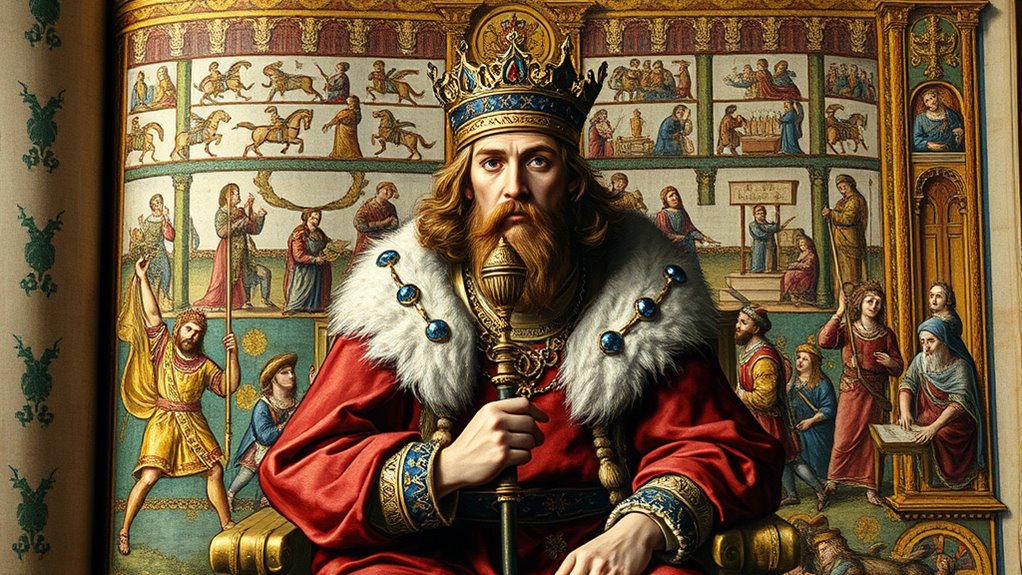

Æthelstan is often called England’s first king because he unified various Anglo-Saxon kingdoms into one nation, strengthening the country’s identity and stability. He fought to defend against Viking invasions and built alliances that helped him secure power. His legal reforms and support for Christianity created lasting institutions. If you want to discover how he laid the foundations for England’s future, there’s much more to explore about his leadership and legacy.
Key Takeaways
- Æthelstan is widely regarded as England’s first king, unifying multiple Anglo-Saxon kingdoms into a single nation.
- He strengthened national identity through the development of a unified legal code and religious reforms.
- Æthelstan successfully defended against Viking invasions, securing the realm with military victories like the Battle of Brunanburh.
- His strategic diplomacy and marriage alliances helped consolidate power and secure loyalty from various kingdoms.
- Æthelstan’s leadership laid the foundations for a centralized, stable monarchy and future nation-building efforts.
Æthelstan, often regarded as England’s first king, played a pivotal role in unifying the diverse Anglo-Saxon kingdoms into a single, cohesive nation. His leadership emerged during a time of frequent Viking influence, which challenged the stability of the region. You might notice that the Vikings had established numerous footholds along the coast and even inside some inland territories, making it clear that any consolidation of power required strategic diplomacy and military strength. Æthelstan’s rise to power was marked by his ability to navigate these threats while also consolidating his position as a ruler. After his father’s death, the royal succession wasn’t always straightforward, especially given the ongoing Viking raids and internal rivalries. Æthelstan’s ascension was carefully managed to secure loyalty from different kingdoms, ensuring that his claim remained uncontested. His skill lay in balancing military might with political alliances, which enabled him to extend his influence over Mercia, Wessex, and Northumbria. His reign also saw the development of a unified legal code, which helped establish the rule of law across the realm.
You’ll see that Æthelstan’s reign was characterized by his efforts to establish a unified legal code and religious authority, which helped solidify his legitimacy. He worked diligently to integrate the various customs and laws of the different kingdoms, creating a sense of national identity. His leadership wasn’t just about military conquest but also about fostering stability and order. In this process, the Viking influence was a constant concern; he had to defend against raids and invasions while also negotiating treaties. His victories at battles like Brunanburh in 937 reaffirmed his dominance and discouraged further Viking incursions. These military successes played an essential role in shaping the future of the English kingdom, setting a precedent for centralized rule. Additionally, his efforts to foster religious unity, such as promoting Christianity and supporting church reforms, contributed to the consolidation of his authority.
When it comes to royal succession, Æthelstan’s reign demonstrated the importance of strategic marriage alliances and loyal councils. He was aware that securing his throne depended on more than just battlefield victories—it required solidifying support among the nobility and clergy. His ability to maintain a stable succession laid the groundwork for future kings, helping to establish a tradition of strong, centralized monarchy. By effectively managing Viking threats and ensuring a smooth royal succession, Æthelstan not only expanded his realm but also created the foundations of what would become a unified England. His leadership proves that unification depended on a delicate balance of military strength, political acumen, and diplomatic skill, all of which he mastered during his remarkable reign.
Frequently Asked Questions
What Was Æthelstan’s Childhood Like?
Your childhood was shaped by a royal upbringing, where you received a thorough childhood education tailored for a future king. You were likely exposed to court life, politics, and religious teachings from a young age. This early training prepared you for leadership, helping you develop the skills and knowledge essential to rule effectively and unite England later in life. Your formative years set the foundation for your remarkable reign.
How Did Æthelstan Unify England?
You see, Æthelstan unified England by strengthening tribal alliances and promoting cultural integration. He forged strategic marriages and alliances with local leaders, bringing together different kingdoms under his rule. Æthelstan also encouraged religious and cultural ties, which helped create a shared identity. This approach reduced conflicts, solidified his authority, and laid the foundation for a unified England, making it more stable and cohesive.
What Were Æthelstan’s Major Military Achievements?
You’ll be amazed by Æthelstan’s daring military feats. He fought off relentless Viking invasions, securing southern England’s borders. His naval battles challenged Viking dominance at sea, turning the tide in his favor. Æthelstan’s strategic prowess and fierce leadership crushed enemy forces, uniting rival kingdoms under his rule. These major military achievements not only defended his kingdom but also laid the foundation for a stronger, more unified England.
How Did Æthelstan Influence English Law?
You see that Æthelstan considerably influenced English law through medieval legal reforms, strengthening royal jurisdiction across his kingdom. He unified laws, making them more consistent, and increased the king’s authority over local courts. His reforms helped centralize power, ensuring the king’s laws took precedence. By establishing clearer legal structures, Æthelstan laid the foundation for a more cohesive and organized legal system that shaped England’s future governance.
What Was Æthelstan’s Legacy After His Death?
You see Æthelstan’s legacy in medieval governance and cultural advancements. After his death, he unified England’s kingdoms, setting a precedent for future kings and strengthening centralized power. His efforts fostered stability and promoted learning, arts, and religious reform, shaping England’s cultural identity. His reign laid the groundwork for a more unified nation, leaving a lasting impact on medieval governance and cultural growth that influenced generations to come.
Conclusion
You now see Æthelstan as the architect who laid the foundation for England’s unity. His leadership stitched together fractured kingdoms like a master weaver, creating a tapestry that endures. By forging alliances and asserting authority, he transformed chaos into stability. His legacy isn’t just in history books but in the very fabric of England itself. Æthelstan’s reign is a beacon that guides the nation, a lighthouse illuminating the path from scattered islands to a united kingdom.