Charles Darwin, the naturalist who reframed life itself, showed that all living beings share common ancestors and evolve through natural selection. During his voyage on the HMS Beagle, he observed species like finches adapting to their environments. His discoveries, supported by fossil records and genetic insights, changed how we comprehend life’s diversity and interconnectedness. Darwin’s ideas shifted science forever, revealing that evolution is ongoing and shaped by natural forces—if you keep exploring, you’ll learn even more about this revolutionary thinker.

Get art and craft supplies delivered free with Prime
- Fast, free delivery on millions of items
- Prime Video, Amazon Music and more included
- Member-only deals all year
Key Takeaways
- Darwin’s observations during the HMS Beagle voyage led to the development of the theory of natural selection.
- His ideas challenged traditional views, proposing species evolve gradually over time.
- Evidence such as fossils, genetic inheritance, and geographic distribution support his theory.
- Darwin’s work transformed biology by explaining the interconnectedness and diversity of life.
- His legacy established evolution as the foundational principle of modern biological sciences.
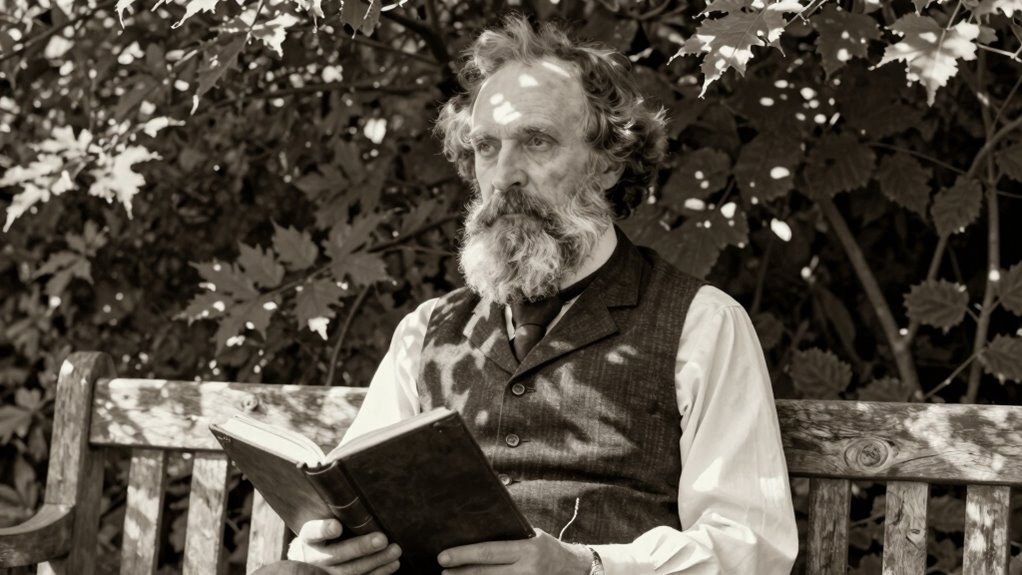
Have you ever wondered how life on Earth has evolved over millions of years? It’s a question that has fascinated humans for centuries, and Charles Darwin‘s work changed how we understand it forever. His groundbreaking ideas, centered around the evolutionary theory, transformed our view of life’s history. Darwin proposed that all living beings share common ancestors and that species change gradually over time. This concept challenged long-held beliefs and paved the way for modern biology. At the core of his ideas is natural selection, a process by which nature “chooses” the most suitable traits for survival. You can think of natural selection as nature’s way of conducting a continuous, intricate test, where only the best-adapted survive and reproduce.
Natural selection is nature’s ongoing test, favoring traits that help species survive and thrive over time.
Darwin’s journey to develop this understanding was fueled by careful observation and collection. During his voyage on the HMS Beagle, he visited the Galápagos Islands and noted striking differences among species of finches. These differences weren’t random; they reflected adaptations to specific environments. Darwin realized that species weren’t fixed or unchangeable but could evolve over generations. His insight was that small variations within populations, when advantageous, get passed on to future generations. Over time, these small changes accumulate, leading to the emergence of new species. This process, known as natural selection, is the mechanism that drives evolutionary change. Additionally, Darwin’s observations of fossil records reinforced the idea that species have changed over vast periods, providing tangible evidence for evolution.
You might find it interesting that Darwin didn’t invent the idea of evolution but provided the strongest scientific evidence for it. His theory integrated a wide range of observations, from fossil records to the geographic distribution of species. By understanding natural selection, you see how environmental pressures shape living organisms, favoring traits that boost survival and reproductive success. It’s a dynamic, ongoing process that continues today. Darwin’s work also demonstrated that evolution isn’t a goal-oriented process but one driven by natural factors acting over vast periods. Furthermore, insights into genetic inheritance and how traits are passed down have provided a deeper understanding of the mechanisms behind evolution. This understanding of artificial selection provided insights into how traits can be intentionally bred and manipulated, shedding light on natural mechanisms of change.
Darwin’s work also demonstrated that evolution isn’t a goal-oriented process but one driven by natural factors acting over vast periods. Today, the evolutionary theory remains central to biology, constantly refined with new discoveries. Darwin’s insights gave us a framework to understand the diversity of life and the interconnectedness of all species. His contribution is profound—reframing life itself, showing that change is the only constant in the biological world. By grasping natural selection, you recognize the beauty of life’s adaptability and the intricate dance of evolution that has shaped everything from tiny microbes to complex humans. Darwin’s legacy is a testament to human curiosity and the power of scientific inquiry to unlock the deepest mysteries of life.
Products Worth Considering

Garmin Venu 3 Fitness Smartwatch, 45 mm, Black

Therabody SmartGoggles 2nd Gen Heated Eye and Temple Massager

GoPro MAX2 Waterproof 360 and Traditional Action Camera with Touch Screen
As an affiliate, we earn on qualifying purchases.
Frequently Asked Questions
How Did Darwin’s Ideas Influence Modern Science?
Darwin’s ideas revolutionized your understanding of life by emphasizing evolutionary mechanisms like natural selection and adaptation. You now see how genetic inheritance passes traits across generations, shaping species over time. His work laid the foundation for modern biology, influencing fields like genetics, medicine, and ecology. You can appreciate how evolution explains the diversity of life and helps scientists predict changes in populations and ecosystems.
What Challenges Did Darwin Face From His Contemporaries?
You face a storm of controversial debates and scientific skepticism, as Darwin’s ideas challenged long-held beliefs about creation and species. His theory of evolution by natural selection sparked fierce opposition from religious and scientific circles alike. Many contemporaries doubted the evidence and questioned its implications, questioning whether it undermined moral and spiritual values. Despite these challenges, Darwin persisted, shaping the foundation of modern biology and changing how we see life itself.
Did Darwin’s Theories Face Religious Opposition?
Yes, Darwin’s theories faced significant religious opposition. You see, during religious debates, many believed his ideas challenged faith vs science, threatening traditional views on creation. Some critics argued that natural selection undermined divine intervention, sparking fierce debates. Darwin’s work prompted people to reevaluate their beliefs, leading to widespread resistance from religious communities, who saw his theory as a direct challenge to their understanding of life’s origins.
How Did Darwin’s Personal Life Impact His Scientific Work?
Your personal struggles and family influence deeply impacted Darwin’s scientific work. His health issues and emotional challenges pushed him to focus intensely on research and reflection. The support and debates within his family, especially from his wife Emma, encouraged him to pursue his ideas despite societal opposition. These personal experiences shaped his perseverance and dedication, ultimately allowing him to develop groundbreaking theories that transformed our understanding of life.
Are Darwin’s Theories Still Accepted Today?
Yes, Darwin’s theories are still widely accepted today. You see, his ideas about evolutionary mechanisms, like natural selection, form the foundation of modern biology. Scientists continue to build on his work using rigorous scientific methodology, testing and refining these concepts. While some debates remain, Darwin’s core principles are fundamental to understanding how species evolve. His work endures because it’s based on solid evidence and scientific inquiry.
Conclusion
As you walk through the tapestry of life Darwin wove, you realize his ideas are the steady heartbeat beneath nature’s song. His theory is the seed, planted deep within the soil of understanding, sprouting new perspectives with every discovery. Like the river’s constant flow, his insights carve pathways through ignorance, guiding you toward truth. In embracing change, you find yourself part of the ongoing dance—a dance shaped by evolution’s gentle, relentless hand.