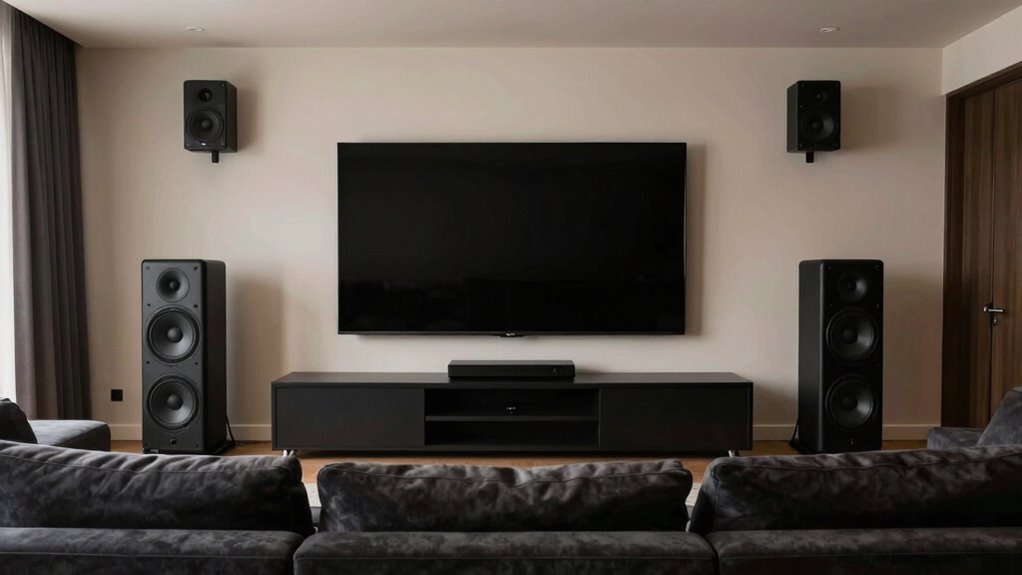

Many buyers underestimate how vital proper speaker placement is for great sound. Placing speakers randomly or ignoring room acoustics can lead to dull, imbalanced audio that ruins your immersion. Overlooking angles, distances, or the importance of calibration often results in less-than-optimal sound quality. Small adjustments can make a huge difference. If you keep an eye on recommended practices, you’ll discover how to optimize your setup for a richer, more immersive home theater experience.
Key Takeaways
- Many buyers underestimate the importance of precise speaker angles and distances for optimal sound immersion.
- Ignoring room acoustics leads to poor placement, causing issues like boomy bass or dull audio.
- Incorrect positioning of surround speakers and subwoofers can unbalance sound and reduce clarity.
- Failing to recalibrate after moving speakers results in imbalanced audio levels and frequencies.
- A focus on aesthetics over proper placement often compromises sound quality and immersive experience.
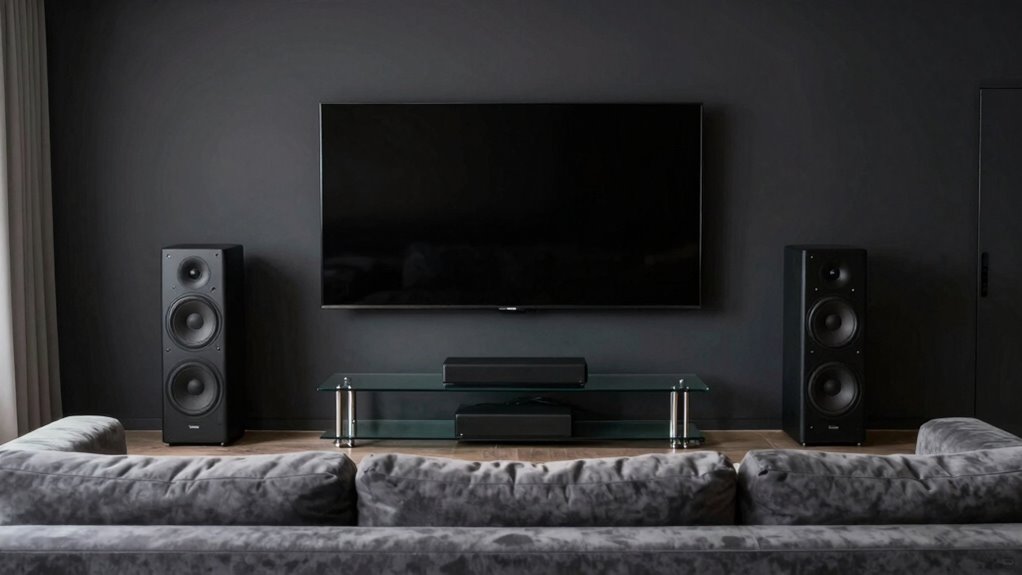
Creating an ideal home theater experience starts with proper speaker placement, as it directly impacts sound quality and immersion. Many buyers overlook this essential step, assuming that simply positioning speakers anywhere will suffice. However, the way you set up your speakers can make or break your viewing experience. One of the most overlooked aspects is sound calibration, which involves fine-tuning your system to match your room’s specific acoustics. Without proper calibration, even the best speakers can sound off or create imbalanced audio. It’s vital to calibrate your system after placement, using a calibration microphone or an automatic room correction feature, to guarantee sound levels and frequencies are balanced. Additionally, understanding room acoustics and how they influence sound can help you make smarter placement choices from the start.
Proper sound calibration after speaker placement ensures balanced, immersive audio for an optimal home theater experience.
Room acoustics play a notable role in how your sound performs. Every room has unique characteristics—walls, furniture, windows, and even ceiling height—that influence sound reflections and absorption. Many people place speakers based on generic guidelines or aesthetic preferences, ignoring how their room’s acoustics will distort the sound. For example, placing speakers too close to walls or corners can cause bass frequencies to amplify unnaturally, resulting in boomy sound. Conversely, large open spaces might dampen certain frequencies, leading to dull audio. You need to understand your room’s acoustics and adapt your speaker placement accordingly. Adding soft furnishings like rugs, curtains, or acoustic panels can help manage reflections and improve overall sound clarity. Proper speaker placement is essential for achieving optimal audio performance in any space.
Another common mistake is positioning speakers at incorrect angles or distances from the listening area. You might think that symmetry looks neat, but the goal is to create an immersive sound field. For surround sound systems, the speakers should be angled toward your ears when seated and positioned at ear level whenever possible. Subwoofers should be placed strategically—away from corners but near the main seating area—to achieve balanced bass response. Remember, even small adjustments in placement can greatly affect how sound reaches your ears, so take your time to experiment. Use a measuring tape and test sounds to find the best spots, and always recalibrate your system afterward.
Ultimately, understanding and applying principles of sound calibration and considering your room’s acoustics will elevate your home theater experience. Proper speaker placement isn’t just about aesthetics; it’s about creating a balanced, immersive environment where every sound detail is crystal clear. When you take the time to get these elements right, you’ll notice a marked difference in sound quality, making every movie or game more engaging than ever.
home theater speaker calibration microphone
As an affiliate, we earn on qualifying purchases.
As an affiliate, we earn on qualifying purchases.
Frequently Asked Questions
How Does Room Shape Affect Speaker Placement?
Room shape considerably impacts speaker placement because it influences room acoustics and speaker orientation. If your room is irregular or oddly shaped, you’ll need to experiment with speaker angles and distances to minimize sound reflections and echoes. Rectangular rooms typically require careful positioning to avoid sound bouncing off walls. Adjust your speakers to optimize sound directionality, ensuring each speaker’s orientation complements your room’s shape for the best audio experience.
What Is the Ideal Distance Between Speakers?
Imagine your speakers are dancers in perfect sync. The ideal distance between them is about 8 to 10 feet, ensuring balanced sound. Keep the speakers at ear level and match their height to your listening position. Good cable management prevents clutter and accidental disconnections. When you position your speakers correctly, with the right distance and height, you’ll achieve immersive sound that feels just right, like a well-choreographed performance.
Should Speakers Be Angled Toward the Listening Area?
Yes, you should angle speakers toward the listening area to guarantee ideal sound. Position your speakers at ear level, aligning their height with your ears when seated. Use acoustic panels to minimize reflections and improve clarity. Proper angling and speaker height create a more immersive experience, while acoustic panels help control sound quality. Adjust the angles slightly inward for the best sound focus, making your home theater truly come alive.
How Do Furniture and Decor Impact Sound Quality?
Furniture and decor considerably impact your sound quality by affecting acoustics. Heavy furniture and plush decor can absorb sound, reducing clarity, while open spaces improve it. To optimize acoustics, incorporate acoustic treatments like rugs, curtains, or wall panels, which help manage sound reflections. Decorative acoustics, such as stylish diffusers or sound-absorbing art, blend function with style, enhancing your home theater experience without sacrificing aesthetics.
Is Speaker Placement Different for Dolby Atmos Setups?
Yes, speaker placement differs for Dolby Atmos setups. You need to position speakers at specific heights, typically using upward-firing or ceiling-mounted speakers, to create the immersive overhead sound experience. The key is to guarantee the Atmos speakers are placed at the correct height, usually around ear level or slightly above, to accurately deliver the overhead effects. Proper placement enhances the clarity and realism of Dolby Atmos audio, making your home theater more immersive.
surround sound speaker placement kit
As an affiliate, we earn on qualifying purchases.
As an affiliate, we earn on qualifying purchases.
Conclusion
Now that you’re armed with the right speaker placement tips, your home theater will feel like a scene straight out of a Spielberg film—minus the popcorn flying everywhere. Remember, even in the age of streaming, proper speaker setup is timeless. Don’t be a Neanderthal about it; take the time to perfect your positioning. Soon enough, you’ll be immersed in crystal-clear sound, making every movie night a blockbuster hit—no DeLorean required.

Focusound 52 Pack Acoustic Foam Panels 1" x 12" x 12" Sound Proof Foam Panles Soundproofing Noise Cancelling Wedge Panels for Home Office Recoding Studio with 300PCS Double-Side Adhesive
- Soundproofing Design: Triangular grooves for noise absorption
- Includes Adhesive Tape: 300pcs double-sided adhesive for easy installation
- Easy Shape Recovery: Soak in water to restore foam shape
As an affiliate, we earn on qualifying purchases.
As an affiliate, we earn on qualifying purchases.

SVS SoundPath Subwoofer Isolation System, 4-Pack
- Affordable and discreet design: Alternative to platforms and risers
- Universal compatibility: Fits any brand with screw-in feet
- Easy installation options: Uses tape or adhesive pads if no threads
As an affiliate, we earn on qualifying purchases.
As an affiliate, we earn on qualifying purchases.