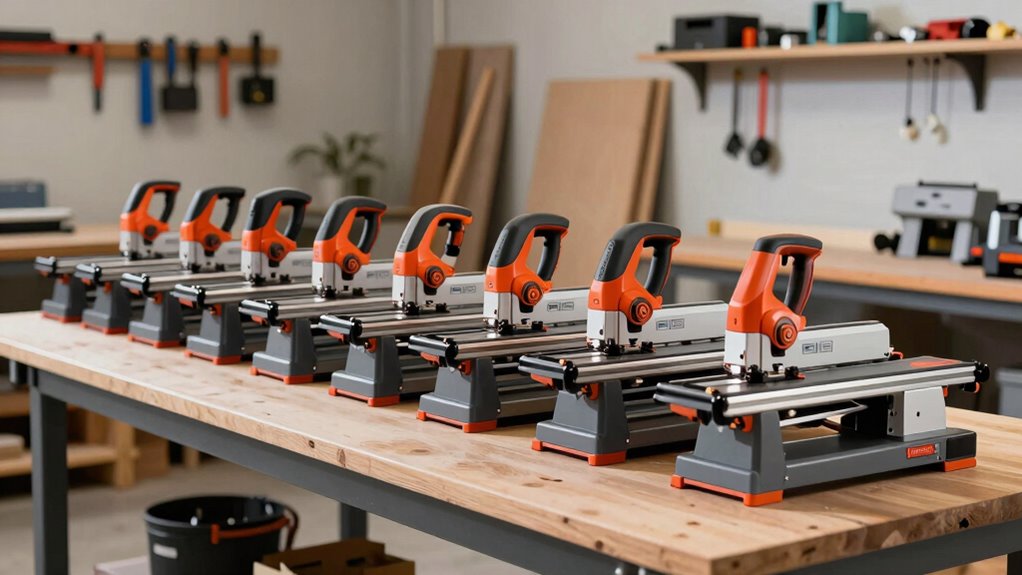

A benchtop band saw can handle curves, resawing, and small stock without taking up the floor space of a full-size machine. My best overall pick is the JET 9-inch for buyers who value a long warranty and a compact format; the WEN 9-inch is a straightforward alternative, while the VEVOR 10-inch with stand offers more capacity and included accessories. The main tradeoff is between a smaller footprint and the extra throat, cutting height, and support offered by larger machines. Motor power, speed options, table stability, and setup demands also vary across this group. Read on for the full breakdown and help matching a saw to your space, materials, and projects.

Get art and craft supplies delivered free with Prime
- Fast, free delivery on millions of items
- Prime Video, Amazon Music and more included
- Member-only deals all year
Complete the kit


Key Takeaways
- The JET 9-inch stands out for warranty coverage, while its compact size still limits cutting capacity compared with the 10- and 13-inch options.
- The WEN and SKIL 9-inch saws suit space-conscious shops; buyers should compare their controls and included features rather than expect them to replace a larger resaw machine.
- Several 10-inch models add useful capacity and two-speed operation, but a stand or larger frame does not automatically mean better blade tracking or greater precision.
- The VEVOR 13.39-inch model is the capacity-focused outlier, making its larger footprint and higher power class a different proposition from the compact 9-inch saws.
- Included accessories and bundles change convenience more than core capability: a foot pedal, fence, miter gauge, or work light cannot compensate for choosing the wrong cutting height or blade.


| bandsaw benchtop | Blade length | Weight |
|---|---|---|
| JET 9" Benchtop Band Saw with | — | 40 lbs |
| WEN 9-Inch Band Saw | 59.5 inches | 40 pounds |
| Skil 2.8 Amp 9-Inch 2-Speed Be | — | — |
| VEVOR 10-Inch Two-Speed Bencht | 72 inches | 74.1 pounds |
| 10-Inch Bandsaw for Woodworkin | 70-1/2 inches | Not specified |
| WEN 9-Inch Band Saw with Foot | 9 inches | — |
| WOODSKIL 10-Inch Benchtop Band | — | — |
| WOODSKIL 9-Inch Band Saw | 59.5 inches | — |
| DeWalt 9" Band Saw with 3.5 Am | 59.5 inches | — |
| VEVOR 13.39-Inch Benchtop Band | — | 180.3 pounds |
| Rikon 10 Inch Bandsaw With Sta | 70.5 inches | 61.8 pounds |
| VEVOR 9-Inch Woodworking Bench | 60 inches | 40.8 pounds |
| Shopmax 4.2 Amp 10-Inch Bencht | 67.4 inches | — |
| SEESII Benchtop Band Saw for W | 55 inches | — |
More Details on Our Top Picks
JET 9″ Benchtop Band Saw with 5-Year Warranty
The JET is a strong fit for woodworkers who want a compact 9-inch saw backed by a longer warranty. Its cast aluminum wheels and precision blade guides are aimed at smooth, controlled cuts, while the 3-1/2-inch resaw capacity covers small stock and general shop work. That capacity matches the WEN 9-Inch model, but the JET distinguishes itself with a five-year warranty; the WEN lists two years and provides a specified 2.8-amp motor, which the JET description does not. The table tilts to 45 degrees, and a fence and miter gauge are included. The tradeoff is limited scale: its 9-inch throat and wood-focused design do not suit larger stock or material versatility. Mounting hardware is also not included.
Pros:- Five-year warranty is longer than the two-year warranty listed for the WEN 9-Inch model.
- Cast aluminum wheels and precision blade guides are intended to support smooth, controlled cutting.
- 3-1/2-inch resaw capacity suits common small-shop woodworking tasks.
- Includes a fence and miter gauge, with table tilt up to 45 degrees.
Cons:- Motor power is not specified in the supplied product details.
- Mounting bolts, washers, and nuts are not included.
- Limited to woodworking and wood composites, with a 9-inch throat.
Best for: Woodworkers who want a compact 9-inch saw for curves and modest resawing, and place particular value on a longer stated warranty.
Not ideal for: Buyers cutting stock wider or taller than a 9-inch benchtop saw can handle, or anyone who needs a specified motor rating or included mounting hardware.
- Blade capacity:9 inches
- Resaw capacity:3-1/2 inches
- Throat size:9 inches
- Table tilt:0–45°
- Dust port:2-1/2 inches
- Dimensions:19 x 14-1/8 x 29 inches
- Weight:40 lbs
- Warranty:5 years
Our verdict“Choose the JET if a compact 9-inch saw and five-year warranty matter more than a published motor rating or larger cutting capacity.”
WEN 9-Inch Band Saw, 2.8-Amp Benchtop
For a buyer comparing compact benchtop saws, the WEN’s main advantage is that its 2.8-amp motor is stated outright. It pairs that rating with a 9-inch cutting width, a 3.5-inch cutting depth, and a table that bevels to 45 degrees, giving it a familiar range for curves and routine woodworking. The JET 9-Inch has the same stated resaw capacity and a longer warranty, but its motor rating is not provided; the WEN instead lists a two-year warranty. A rip fence and miter gauge come in the package, so basic guided cuts do not require sourcing those accessories separately. Its limitations are also clear: it is described for wood only, and the supplied information does not include blade-change tools. Buyers planning frequent material changes may need additional blades and equipment.
Pros:- Specified 2.8-amp motor gives buyers a concrete power figure for comparison.
- Cuts up to 3.5 inches deep and 9 inches wide for common small-shop work.
- Table bevels up to 45 degrees for angled cuts.
- Rip fence and miter gauge are included.
Cons:- Two-year warranty is shorter than the JET 9-Inch model’s five-year warranty.
- Product details describe it for wood cutting only.
- Blade-change tools are not included, and other blade options may be needed for different tasks.
Best for: Hobby woodworkers who want a compact 9-inch saw with a published motor rating, beveling table, fence, and miter gauge for routine wood projects.
Not ideal for: Buyers who want a longer stated warranty, included blade-change tools, or a saw intended for materials beyond wood.
- Motor:2.8 amps
- Voltage:120 volts
- Wattage:336 watts
- Speed:2500 rpm
- Blade length:59.5 inches
- Cutting capacity:3.5 inches deep; 9 inches wide
- Cutting angle:Up to 45°
- Weight:40 pounds
- Warranty:2 years
Our verdict“Pick the WEN when a stated 2.8-amp motor and included cutting guides matter more than a longer warranty or broader material use.”
Skil 2.8 Amp 9-Inch 2-Speed Benchtop Band Saw for Woodworking – BW9501-00
The SKIL earns its place among the 9-inch options through two-speed operation and adjustment features that are useful when moving between different woodworking cuts. Tool-free belt tensioning and quick blade tension and angle adjustments reduce setup friction, while the dust port offers a way to connect extraction and limit debris around the work. Like the WEN 9-Inch, it specifies a 2.8-amp motor; unlike the WEN, the supplied details emphasize two speeds and tool-free tensioning rather than listing a warranty or a 45-degree table angle. Its 9-inch blade format keeps it in the compact benchtop class, not the larger-capacity territory of the VEVOR 10-Inch. The available specs do not state a resaw height, so buyers needing a confirmed cutting depth should check that before choosing. It also lacks the advanced adjustments of higher-end machines.
Pros:- Two-speed drive adds flexibility for different woodworking cuts.
- Tool-free belt tensioning simplifies speed and setup adjustments.
- Quick blade tension and angle adjustments support easier setup.
- Dust port can help manage sawdust when connected to extraction.
Cons:- 9-inch blade format limits the scale of work compared with the VEVOR 10-Inch.
- Supplied product details do not state a resaw capacity or warranty.
- Basic feature set may not provide the adjustments available on higher-end saws.
Best for: Woodworkers with limited bench space who want two-speed control, convenient blade adjustments, and a dust-port connection for varied small projects.
Not ideal for: Buyers who need a stated resaw capacity, a larger throat, or clearly listed table-tilt and warranty details before purchase.
- Motor:2.8 amps
- Power source:Corded electric
- Voltage:120 volts
- Wattage:336 watts
- Blade size:9 inches
- Drive:Two-speed
- Blade teeth:24
- Dimensions:24.02 x 15.16 x 12.4 inches
Our verdict“Choose the SKIL for two-speed control and convenient adjustments in a compact woodworking saw, but verify cutting capacity if resaw height is a deciding factor.”
VEVOR 10-Inch Two-Speed Benchtop Band Saw with Stand, 373W, Cast Iron Table, 6-Inch Max Cutting Height, with Work Light, Miter Gauge, Fence
The VEVOR is the capacity-focused choice here: its 10-inch width and 6-inch maximum cutting height exceed the stated dimensions of the JET and WEN 9-inch saws, making it better suited to taller stock. A cast iron table adds a substantial work surface, and the included stand means buyers can set it up as a floor-standing machine rather than planning around a bench. Two speeds, a fence, a miter gauge, and a 360-degree LED work light round out a practical package for shop use. That extra reach comes with real compromises: at 74.1 pounds, it is far less convenient to move than the 40-pound JET and WEN. Its one-year warranty is also shorter than the JET’s, and six inches remains a limit for especially tall resaw work.
Pros:- 6-inch maximum cutting height exceeds the stated 3-1/2-inch resaw capacity of the JET 9-Inch.
- Cast iron table provides a substantial work surface.
- Stand, fence, and miter gauge are included.
- 360-degree LED work light supports visibility around the cutting area.
Cons:- At 74.1 pounds, it is harder to move than the 40-pound JET and WEN models.
- One-year warranty is shorter than the JET 9-Inch model’s five-year coverage.
- Six-inch maximum cutting height still limits taller resaw projects.
Best for: Woodworkers who need more cutting height than a 9-inch benchtop saw provides and want a stand, fence, miter gauge, and work light included.
Not ideal for: Small-shop owners who need to move or store the saw often, or buyers seeking a longer warranty or capacity beyond six inches.
- Motor power:373W
- Blade length:72 inches
- Maximum cutting height:6 inches
- Maximum cutting width:10 inches
- Blade speed:3240 feet per minute
- Table dimensions:13.2 x 13.4 inches
- Dimensions:23.62 x 19.69 x 62.2 inches
- Weight:74.1 pounds
- Warranty:1 year
Our verdict“Choose the VEVOR if taller stock and a stand-included setup outweigh portability and a shorter warranty.”
10-Inch Bandsaw for Woodworking with Dual-Speed Adjustment and Steel Frame
This 10-inch saw makes the most sense for buyers who want more table area and a wider speed range than the compact 9-inch models offer. Its 20.5 x 17.5-inch table is notably larger than the VEVOR 10-Inch’s 13.2 x 13.4-inch table, giving workpieces more support during guided cuts. Dual speeds of 1515 and 3280 FPM, a 1/2 HP motor, and a table that tilts right 45 degrees and left 5 degrees add flexibility for different wood and angle work. The stated 4-3/4-inch cutting height, however, is below the VEVOR’s six inches, so the larger table does not make this the better pick for taller resaw stock. The product data also leaves weight unspecified, making portability and bench or stand planning harder to judge.
Pros:- Large 20.5 x 17.5-inch table offers more support than the VEVOR 10-Inch’s listed table.
- Dual speeds of 1515 and 3280 FPM accommodate different cutting needs.
- 1/2 HP, 5.3-amp motor rating is specified.
- Table tilts 45 degrees right and 5 degrees left.
Cons:- 4-3/4-inch cutting height is lower than the VEVOR 10-Inch’s six-inch capacity.
- Weight is not specified, complicating decisions about portability and bench support.
- Supplied details do not state warranty coverage or noise and vibration levels.
Best for: Woodworkers who prioritize a roomy table, dual feed speeds, and a tilting work surface for medium-sized projects.
Not ideal for: Buyers who need the greatest cutting height in this group, or who need confirmed machine weight before planning a benchtop installation.
- Blade length:70-1/2 inches
- Motor:1/2 HP, 5.3 A
- Voltage:120 V
- Blade speeds:1515 and 3280 FPM
- Cutting height:4-3/4 inches
- Throat width:9-5/8 inches
- Table size:20.5 x 17.5 inches
- Table tilt:45° right; 5° left
- Weight:Not specified
Our verdict“Pick this model for its generous table and dual-speed setup, but choose the VEVOR 10-Inch instead if maximum cutting height is the priority.”
WEN 9-Inch Band Saw with Foot Pedal Switch Bundle
The bundle’s defining advantage is its foot pedal switch, which frees both hands to guide stock—a practical difference for repeat cuts or awkward workpieces. The saw itself pairs a 2.8-amp motor with a 3-1/2-inch cutting depth and a 9-inch throat, matching the core capacity of the standard WEN 9-Inch Band Saw. This bundle adds the pedal rather than more cutting capacity, so buyers choosing between them should decide whether hands-free switching is worth prioritizing over a simpler setup.
A 12-1/4 by 11-7/8-inch table, 45-degree bevel, rip fence, and miter gauge give it useful flexibility for a compact machine. The tradeoff is its 9-inch limit: the WOODSKIL 10-Inch model offers a deeper 5-1/8-inch cut. Setup may also take patience, and the pedal requires a compatible 120V machine.
Pros:- Foot pedal switch allows hands-free power control.
- Rip fence and miter gauge support straight and angled work.
- Table tilts up to 45 degrees for bevel cuts.
- 3-1/2-inch cutting depth suits many small-shop projects.
Cons:- 9-inch throat limits the width of workpieces.
- Foot pedal requires a compatible 120V machine rated for up to 15 amps.
- Setup may be complex for first-time bandsaw owners.
Best for: Woodworkers making repeated small-part cuts who want to control power with a foot pedal while keeping both hands on the work.
Not ideal for: Buyers cutting thick stock or wide panels, since the 3-1/2-inch depth and 9-inch throat are smaller than the WOODSKIL 10-Inch model’s capacity.
- Motor power:2.8 amps
- Blade length:9 inches
- Blade speed:Up to 2500 feet per minute
- Cutting capacity:3-1/2 inches deep, 9 inches wide
- Work table:12-1/4 x 11-7/8 inches
- Bevel capacity:Up to 45 degrees
- Blade width range:1/8 to 3/8 inches
- Included accessories:Rip fence, miter gauge, adjustable blade guard
- Warranty:Two years
Our verdict“Choose this bundle over the standard WEN 9-Inch if foot-controlled switching matters more to you than extra cutting capacity.”
WOODSKIL 10-Inch Benchtop Bandsaw with Stand, 3.4A Dual-Speed Band Saw
Among the compact saws here, this WOODSKIL earns its place through 5-1/8 inches of cutting height and a 10-inch throat. That extra depth is a meaningful step up from the WEN 9-Inch bundle’s 3-1/2-inch capacity, giving buyers more room for taller stock without moving to the much larger VEVOR 13.39-Inch model. Its dual blade speeds—2360 and 3000 FPM—offer a choice for different woodworking tasks, while ball-bearing guides are intended to support controlled detail cuts.
The stand is included, which makes this a more ready-to-place option than a benchtop-only saw, and tool-free doors plus quick tensioning can simplify blade access. The tradeoff is a larger overall setup, and the 10-inch throat still limits wide workpieces. The listed specifications also omit motor and power-supply details, so I’d favor a better-documented model if those are essential to your decision.
Pros:- 5-1/8-inch cutting height handles taller stock than the 9-inch options.
- Two blade speeds provide a choice for different woodworking cuts.
- Included stand supports a dedicated working setup.
- Quick tension system and tool-free doors simplify blade access.
Cons:- 10-inch throat still restricts the width of larger workpieces.
- Product data does not specify motor or power-supply details.
- Stand assembly and the larger setup may take more effort and space.
Best for: Woodworkers who need more vertical cutting room than a 9-inch saw provides and want a stand included for a dedicated shop station.
Not ideal for: Buyers who need clear electrical specifications or a compact, easy-to-store benchtop machine; its stand and larger dimensions take more space than the WEN 9-Inch.
- Power:3.4A
- Blade speeds:2360 FPM and 3000 FPM
- Cutting height:5-1/8 inches
- Throat depth:10 inches
- Cutting angle:0 to 45 degrees
- Stand:Included
- Blade access:Quick tension system and tool-free doors
- Warranty:Two years
Our verdict“Pick this WOODSKIL over the WEN 9-Inch when extra cutting height and an included stand matter more than a compact footprint.”
WOODSKIL 9-Inch Band Saw, 3-Amp Benchtop Bandsaw, 2500 FPM Blade Speed
This WOODSKIL is a straightforward pick for buyers who want a 9-inch benchtop bandsaw with a little more motor power on paper than the 2.8-amp WEN models. Its 3-amp motor runs the blade at 2500 FPM, and the stated 3-1/2-inch depth and 9-inch width keep it in the same compact-capacity class as the WEN foot-pedal bundle. The distinction is simpler operation: there’s no bundled foot pedal, so the WEN is the better fit if hands-free switching is a priority.
A steel base and tilting table give this saw a useful foundation for routine woodworking and bevel cuts up to 45 degrees. The product description also mentions soft-metal cutting, but the listed details don’t specify material limits or blade requirements, so I would treat that claim cautiously. At 40 pounds, it is movable with some effort, but it is not a featherweight machine; its basic feature set also lacks the larger capacity of the WOODSKIL 10-Inch.
Pros:- 3-amp motor and 2500 FPM blade speed suit routine small-shop cuts.
- Cuts up to 3-1/2 inches deep and 9 inches wide.
- Table tilts from 0 to 45 degrees for bevel work.
- Steel base supports a stable benchtop setup.
Cons:- Cutting depth remains limited to 3-1/2 inches.
- At 40 pounds, moving or storing it takes some effort.
- Basic feature set offers fewer conveniences than the WEN foot-pedal bundle.
Best for: Small-shop woodworkers who want a basic 9-inch saw with a 3-amp motor, a steel base, and a tilting table.
Not ideal for: Buyers who need deeper cuts, added operating conveniences, or clear guidance for cutting materials beyond wood; the WOODSKIL 10-Inch offers more height.
- Power source:AC 120V
- Motor power:3 A
- Wattage:360 watts
- Blade length:59.5 inches
- Blade speed:2500 FPM
- Maximum cutting capacity:3.5 inches deep, 9 inches wide
- Table tilt:0 to 45 degrees
- Table size:12-5/16 x 11-7/8 inches
- Item weight:40 pounds
Our verdict“Choose this WOODSKIL for a simple 9-inch woodworking setup, but step up to the 10-inch model if you need more cutting height.”
DeWalt 9″ Band Saw with 3.5 Amp Motor and Two-Speed Operation
The DeWalt’s case rests on two blade speeds, a 3.5-amp motor, and an integrated LED worklight—not extra capacity. Its compact 9-inch format makes it a fit for small workshops, while the two-speed setup gives the operator a choice between 1700 and 2500 SPM for light woodworking tasks. Compared with the WOODSKIL 9-Inch, it adds lighting and dual dust-port adapters; compared with the WOODSKIL 10-Inch, it gives up the taller 5-1/8-inch cut.
The LED light can help keep the cutting line visible, and the dust ports provide connection points for cleanup equipment. Those conveniences do not change the saw’s stated focus on wood and engineered wood, so it is a narrower choice than the VEVOR 13.39-Inch, which lists a broader range of materials and much greater capacity. Its 40-pound weight and corded 120V power also make it less convenient to relocate than a smaller, lighter benchtop tool.
Pros:- 3.5-amp motor and two speed settings offer useful control for light woodworking.
- Integrated LED worklight helps illuminate the cut line.
- Dual dust-port adapters provide options for connecting dust collection.
- Compact dimensions suit smaller workshops.
Cons:- 9-inch format limits capacity compared with the WOODSKIL 10-Inch.
- Listed material compatibility is limited to wood and engineered wood.
- Corded 120V power and 40-pound weight restrict portability.
Best for: Woodworkers in compact shops who want two speed settings, a built-in worklight, and dust-port connections for routine wood cuts.
Not ideal for: Buyers cutting tall stock, seeking cordless operation, or needing a saw for a broad range of materials; its stated compatibility centers on wood and engineered wood.
- Power source:Corded electric
- Voltage:120 volts
- Motor power:3.5 amps
- Wattage:420 watts
- Blade length:59.5 inches
- Blade speeds:1700 and 2500 SPM
- Cutting angle:Up to 45 degrees
- Special features:LED worklight, dual dust ports, miter gauge
- Item weight:40 pounds
Our verdict“Choose the DeWalt over the WOODSKIL 9-Inch if lighting and dust-port options matter more than a basic, lower-feature setup.”
VEVOR 13.39-Inch Benchtop Band Saw with Stand, 440-846 RPM Variable Speed, 1100W (1.5 HP), 110V, Optimized Work Light and Miter Gauge – Woodworking, Metal, Copper
This VEVOR is in a different size class from the 9- and 10-inch benchtop saws here. Its 13.39-inch throat and listed 13-inch cutting height provide far more room than the WOODSKIL 10-Inch’s 10-inch throat and 5-1/8-inch height, while its 1100W (1.5 HP) motor and variable-speed control target work beyond small woodworking cuts. The description lists wood, metal, copper, aluminum, and plastic, making it the broadest material-use option in this batch.
A tilting table, work light, and miter gauge support varied cuts, and the included stand gives the machine a stable base. But this is a substantial shop installation rather than an easy-to-store benchtop saw: at 180.3 pounds and over 71 inches tall, it takes considerable floor space and is difficult to relocate. The listed speed range is 440–846 RPM, while the maximum blade speed is separately stated as 2887.5 FPM; buyers should distinguish those figures when matching blade speed to a material.
Pros:- 13.39-inch throat and 13-inch listed cutting height exceed the smaller saws in this batch.
- 1100W (1.5 HP) motor and variable-speed control support a broad range of cutting tasks.
- Product description lists wood, metal, copper, aluminum, and plastic compatibility.
- Included stand, tilting table, work light, and miter gauge support a dedicated shop setup.
Cons:- At 180.3 pounds, it is difficult to move once installed.
- Large dimensions require substantial floor space.
- Separate RPM and maximum FPM figures may require clarification when selecting a cutting setup.
Best for: Woodworkers or makers with a permanent shop who need greater cutting capacity and want one listed machine for wood, metal, copper, aluminum, and plastic.
Not ideal for: Small-shop owners who need a portable benchtop saw or lack floor space; its 180.3-pound weight and 71.46-inch height make it a fixed-station choice.
- Cutting height:13 inches
- Throat width:13.39 inches
- Sawblade length:109.45 inches
- Maximum blade speed:2887.5 ft/min
- Speed range:440-846 RPM
- Motor power:1100W (1.5 HP)
- Voltage:110V
- Table tilt:0 to 45 degrees
- Weight:180.3 pounds
Our verdict“Choose this VEVOR over the smaller WOODSKIL models only if your shop has room for a heavy stand-mounted saw and you need its added capacity and material range.”
Rikon 10 Inch Bandsaw With Stand
The Rikon makes the most sense for a hobbyist who wants a 10-inch saw with its own stand, rather than a compact machine that needs a dedicated bench. Its welded steel frame and tilting cast-iron table give it a sturdier, more substantial setup than the VEVOR 9-inch, while tool-less blade guides and quick-release tension simplify routine blade adjustments. The included rip fence and miter gauge also mean fewer accessories to source before starting basic shop projects.
That convenience comes with a footprint to plan around: at 59 inches tall and 61.8 pounds, it is not a lightweight benchtop unit to move between work areas. Its cutting capacity is still limited for larger stock, and the basic feature set is less suited to professional workloads than the Shopmax 10-inch, which lists a 4.5-inch cutting depth. Choose the Rikon for a more complete small-shop setup, not for heavy production or oversized cuts.
Pros:- Welded steel frame provides a sturdy structure for workshop use
- Tool-less blade guides and quick-release tension make blade adjustments more convenient
- Tilting cast-iron table supports angled cuts
- Includes a stand, rip fence, and miter gauge
Cons:- Limited cutting capacity restricts work with larger pieces
- Basic feature set may fall short for professional workloads
- At 61.8 pounds, setup may require help and it is not easy to move
Best for: Hobbyist woodworkers who want a 10-inch saw, included stand, and basic cutting accessories for a small workshop.
Not ideal for: Professional users or people who regularly cut large stock; its listed capacity is limited, and its weight makes setup and relocation harder.
- Power source:Corded electric
- Blade length:70.5 inches
- Blade material:High-carbon steel
- Cutting angle:Up to 45 degrees
- Speed:43.75 feet per second
- Dimensions:25.75 x 17.5 x 59 inches
- Weight:61.8 pounds
- Included accessories:Steel stand, rip fence, and miter gauge
Our verdict“Choose the Rikon if you want a well-equipped 10-inch bandsaw and included stand for hobby work, but skip it if you need greater capacity or easy portability.”
VEVOR 9-Inch Woodworking Benchtop Bandsaw with 1/2 HP Motor
The VEVOR 9-inch is a sensible match for a small workshop where a full-height saw would take up too much room. Its 40.8-pound body and roughly 19-by-15-inch footprint are easier to place on a bench than the stand-equipped Rikon, while the 0.5 HP motor and stated 3.5-inch cutting height provide useful capacity for routine woodworking. A tilting cast-aluminum table, fence, and miter gauge give it more setup flexibility than a bare-bones compact saw.
Its limits are easy to see beside the Shopmax 10-inch: the VEVOR offers a 9-inch width and 3.5-inch height, while Shopmax lists 10 inches and 4.5 inches of cutting depth. The VEVOR’s table is also smaller at 11.8 inches square, which leaves less room to support broad workpieces. Pick it for ordinary cuts in a constrained shop; skip it if your projects regularly exceed its listed capacity or you need a machine designed for frequent heavy cuts.
Pros:- Compact dimensions suit crowded workbenches
- 0.5 HP motor is paired with a stated 3.5-inch cutting height
- Tilting cast-aluminum table supports bevel cuts
- Includes both a fence and miter gauge
Cons:- 9-inch cutting width and 3.5-inch height limit larger workpieces
- 11.8-inch-square table offers restricted support for broad stock
- At 40.8 pounds, it is not especially convenient for frequent carrying
Best for: Woodworkers with limited floor space who want a bench-mounted saw for small furniture parts, craft stock, and general hobby cuts.
Not ideal for: Buyers cutting wide or thick stock regularly, or anyone seeking a truly portable saw; its capacity is modest and its 40.8-pound weight is still substantial.
- Motor power:0.5 HP
- Blade length:60 inches
- Maximum cutting height:3.5 inches
- Table dimensions:11.8 x 11.8 inches
- Table material:Cast aluminum
- Tilting range:0–45 degrees
- Speed:2,695 feet per minute
- Weight:40.8 pounds
- Dimensions:18.7 x 14.96 x 28.74 inches
Our verdict“Choose this VEVOR for a space-conscious hobby bench and moderate-sized cuts, but opt for the Shopmax if you need more stated width and depth.”
Shopmax 4.2 Amp 10-Inch Benchtop Band Saw
Among these four, the Shopmax has the strongest stated case for cutting larger stock on a benchtop machine: it lists a 10-inch cutting width and 4.5-inch maximum depth. That gives it more room than the VEVOR 9-inch’s 3.5-inch cutting height, and the 4.2-amp induction motor is aimed at more demanding work than light craft cuts. Heavy-duty steel construction and ball-bearing pulleys are intended to support steady blade movement, while the table tilts up to 45 degrees for bevel work.
The tradeoff is a less ready-to-go package than the Rikon 10 Inch, which includes a stand and basic cutting accessories. Shopmax arrives partially assembled, and dust extraction requires a separate Shopmax extractor; the supplied data lists only a hardware bag as included. It is the better fit if cutting capacity leads your decision, but the absent listed fence and miter gauge details may matter to buyers who want a complete setup out of the box.
Pros:- Listed 10-inch cutting width and 4.5-inch depth exceed the VEVOR 9-inch’s stated capacity
- 4.2-amp induction motor is suited to more demanding woodworking cuts
- Steel construction and ball-bearing pulleys support a stable cutting setup
- Table tilts up to 45 degrees for angled work
Cons:- Requires some assembly before use
- Dust extractor is sold separately
- Supplied product details do not list a stand, fence, or miter gauge
Best for: Small-shop woodworkers who need more stated cutting width and depth for thicker stock but still want a benchtop-sized saw.
Not ideal for: Buyers who want an immediately complete package with a stand, fence, and miter gauge, or who do not want to arrange separate dust extraction.
- Motor:4.2-amp induction motor
- Maximum cutting depth:4.5 inches
- Maximum cutting width:10 inches
- Blade length:67.4 inches
- Blade width range:0.14–0.47 inches
- Table angle adjustment:Up to 45 degrees
- Construction:Heavy-duty steel
- Dust extraction:Compatible Shopmax extractor sold separately
- Assembly:Partially assembled
Our verdict“Pick the Shopmax when greater listed cut capacity matters more than a fully accessorized package or included dust collection.”
SEESII Benchtop Band Saw for Woodworking: 3A-120V Bandsaw with 8″ Cutting Width, Max 3-1/8″ Cutting Height, Tilting Worktable & Miter Gauge
The SEESII is the narrowest-capacity choice here, which can be an advantage for a buyer focused on small parts and detailed woodworking rather than broad stock. Its 8-inch cutting width and 3-1/8-inch maximum height set a clear boundary: it gives up room compared with the VEVOR 9-inch and falls further behind the Shopmax 10-inch for larger cuts. In return, its 12-by-12-inch table, tilting work surface, miter gauge, and double-sided fence are aimed at controlled work on manageable pieces.
The 350-watt, 120V motor and 900-rpm speed are provided in the product data, but they do not establish an advantage over the other saws’ motor specifications. The dust collection port is useful for shop cleanup, though it does not remove the need for a collection system. Assembly is required, and there is no included stand or wheels, unlike the stand-equipped Rikon. Choose this for detailed bench work, not as a substitute for a higher-capacity cutting station.
Pros:- Miter gauge and double-sided fence support guided, repeatable cuts
- Tilting worktable allows cuts up to 45 degrees
- 12-by-12-inch table provides a defined work surface for small pieces
- Dust collection port can connect to a shop collection setup
Cons:- 8-inch cutting width is narrower than the VEVOR 9-inch and Shopmax 10-inch
- Maximum cutting height of 3-1/8 inches limits thicker stock
- Requires assembly and includes no stand or wheels
Best for: Craft woodworkers and hobbyists who mainly cut small pieces and want a compact saw with a miter gauge and tilting table.
Not ideal for: Woodworkers handling wide panels or thick stock, or buyers who need a stand or easy mobility included.
- Power:350 watts
- Voltage:120V
- Speed:900 rpm
- Cutting width:8 inches
- Maximum cutting height:3-1/8 inches
- Blade length:55 inches
- Maximum cutting angle:45 degrees
- Work table size:12 x 12 inches
- Dimensions:17 x 12 x 27 inches
Our verdict“Choose the SEESII for small, guided woodworking cuts on a bench, but select a wider saw if your projects involve larger stock.”

How We Picked
I compared these 14 saws around the decisions that matter in a benchtop shop: cutting capacity, motor and speed options, usable work support, footprint, and setup needs. I also looked at what the listings specify about tables, stands, fences, miter gauges, lighting, and warranty coverage, since those details affect day-to-day use but do not carry equal weight. A larger advertised capacity matters only if it fits the buyer’s stock and workspace; similarly, more accessories do not automatically make a saw more accurate or easier to tune.
The ranking favors balanced fit and clearly useful differences over the biggest number on a spec sheet. The JET leads for buyers seeking a compact model backed by a stated five-year warranty; the smaller WEN and SKIL options earn consideration for basic shop use, while larger dual-speed machines rank higher for added capacity and flexibility. Models with limited published detail, unusual bundles, or a much larger footprint are more specialized picks rather than universal recommendations. I do not treat advertised specifications as proof of cutting accuracy, and buyers should confirm the exact configuration and blade capacity before ordering.
Factors to Consider When Choosing Bandsaw Benchtop
Use these broader checks to narrow the field before choosing a model. The right benchtop saw depends less on its headline size than on the stock you cut, your available bench or floor space, and how much setup you are willing to do.
Match Cutting Height and Throat to Real Projects
Cutting height limits how thick a workpiece can pass beneath the guides, while throat capacity limits the distance between the blade and frame. Those measurements answer different questions, so a saw with a wider throat may still be unsuitable for thick stock. List the largest pieces you expect to cut, then compare their dimensions with the manufacturer’s stated capacity. Leave some room for workholding and safe handling instead of buying exactly to the largest planned cut. A common mistake is treating a 10-inch or 13-inch label as a direct measure of every kind of capacity. If your projects mostly use small blanks and curves, a compact 9-inch model may be easier to place and tune than a larger machine you rarely use to its limits.
Choose Speed for the Materials You Actually Cut
Two-speed and variable-speed controls can help when a shop cuts different materials or needs to match blade speed to the task. They are not a substitute for a suitable blade, correct tension, or steady feed. Woodworkers who mainly cut wood may get more practical value from dependable setup and easy blade changes than from extra speed settings. If you expect to cut metal, confirm that the specific saw, blade, and speed range are approved for that material; a listing that mentions multiple materials is not enough by itself. Avoid assuming that a higher motor rating guarantees faster, cleaner work through every stock size. Match the motor and speed features to your workload, and check whether changing settings is simple enough to use regularly.
Plan for the Base, Stand, and Available Space
Benchtop does not always mean small or ready to use on a bench: some models include a stand, while others need a stable surface supplied by the owner. Measure the machine, stand, and the space needed to feed long workpieces before choosing. A sturdy, level base can reduce unwanted movement and make setup less frustrating, but a stand also takes floor space and may add assembly. Check whether the listed footprint includes the stand and whether the unit can be safely secured to your bench. Buyers often focus on storage dimensions and forget the room needed to move material around the blade. For an especially small shop, a lighter compact saw may be a better fit than a larger model with more capacity.
Treat Guides, Table, and Blade Setup as Part of the Purchase
Accurate cuts depend on the whole setup, not just the motor. A stable table, properly adjusted blade guides, correct blade tension, and a suitable blade all affect how reliably the saw follows a line. Included fences and miter gauges can help with repeat cuts, though their presence alone does not tell you how precise or rigid they are. Before buying, check how the manufacturer describes blade size, guide adjustment, table tilt, and replacement-blade availability. New owners commonly blame the machine for wandering cuts when the blade is dull, incorrectly tensioned, or poorly suited to the curve. Budget time to tune the saw and learn its adjustments, especially if consistent resawing is a priority.
Decide Which Accessories Add Real Shop Value
Bundles and convenience features should support a job you already expect to do. A foot pedal can leave both hands available for controlling work, while a light can help illuminate the cut line and a fence can support repeatable straight cuts. A miter gauge is useful for some angled work, but it does not replace careful setup or a suitable jig. Compare bundle contents with the base machine so you do not pay attention to accessories while overlooking cutting capacity or table stability. Check whether accessories are adjustable, removable, and compatible with common shop practices. When a feature is rarely used, a simpler model with a better fit for your main cuts may be the smarter choice.
Know When a Larger Saw Is Worth the Space
Paying for more capacity makes sense when your regular stock genuinely needs it or when a broader range of cuts matters to your work. Larger frames can bring a wider throat or greater cutting height, but they also demand more room and may need a more substantial support surface. A compact saw is often easier to store and adequate for small craft pieces, trim, and curved cuts. Do not buy a larger machine just because its headline dimensions look future-proof; consider how often you will use the extra capacity and whether your shop can support the footprint. For frequent thick-stock work, compare capacity, blade options, and motor details together rather than relying on size alone. If that workload becomes routine, a full-size floor model may suit the task better than any benchtop option.
Frequently Asked Questions
Is a 9-inch benchtop band saw enough for woodworking?
A 9-inch saw can suit small-shop woodworking when most cuts involve modest stock, curves, templates, or craft pieces. Its capacity is the main constraint, so check both throat and maximum cutting height against the largest workpieces you actually plan to handle. It is less suited to frequent thick-stock resawing or wide work that needs substantial clearance. A smaller machine can still be useful when paired with the right blade and careful setup. If your projects are likely to grow, compare the capacity of the 10-inch models before settling on a compact format.
Should I choose a two-speed or variable-speed benchtop band saw?
Choose speed adjustment based on your material mix, not just the number of settings. Two speeds can offer a practical choice for buyers who alternate between tasks, while variable speed gives finer adjustment when the saw and blade are suited to that range. If you mostly cut wood, a good blade, stable setup, and adequate capacity may matter more than speed flexibility. For metalwork, verify the manufacturer’s permitted materials and speeds, then select a blade designed for the material. Do not assume speed adjustment alone makes a wood-focused saw appropriate for metal cutting.
Does a benchtop band saw with a stand need to be bolted down?
A stable base matters for control and repeatability, but the correct mounting method depends on the machine and stand instructions. Follow the manufacturer’s directions and check whether the stand is designed to support the saw without additional anchoring. On a bench, confirm that the surface is level, sturdy, and large enough to support the saw without overhang. A stand can improve working height and free bench space, though it also takes up floor area. Avoid operating a saw on an unstable or improvised support, especially when feeding larger workpieces.
Can these benchtop band saws cut metal as well as wood?
Do not assume every benchtop band saw is suitable for metal just because a product listing mentions metal or variable speed. Confirm the manufacturer’s approved materials, speed range, blade requirements, and any cooling or operating instructions for the exact model. A blade intended for wood is not the right choice for metal, and unsuitable speed or setup can create poor cuts or unsafe conditions. Some models are marketed for broader material use, but their detailed specifications still need checking. If metal cutting is a regular requirement, choose a saw specifically rated for that work rather than relying on a general-purpose description.
When should I choose a larger benchtop saw instead of a 9-inch model?
Choose a larger model when its stated throat or cutting height solves a real project constraint, such as wider stock or thicker workpieces. First measure the material and compare it with both capacity figures; the nominal saw size alone does not tell the whole story. Then account for stand or bench space, workpiece clearance, and the effort needed to move and tune the machine. If you only occasionally need extra capacity, outsourcing a cut or using another tool may be more practical than dedicating shop space to a larger saw. For routine heavy resawing, consider whether a full-size floor saw is a better match than a benchtop machine.
Conclusion
For the best overall balance, I would start with the JET 9-inch if a compact footprint and its stated five-year warranty suit your needs. For best value and beginner-friendly simplicity, compare the WEN 9-inch and SKIL 9-inch options, choosing between them based on the controls and features you prefer. The best premium or capacity-focused direction is the larger VEVOR 13.39-inch model, provided its footprint and material ratings fit your shop and work. For a middle ground, the 10-inch dual-speed models offer more room than the 9-inch saws without moving all the way to the largest machine. If you need a foot pedal, stand, work light, or included measuring accessories, choose the bundle or configuration that provides that specific convenience—but let cutting capacity, blade setup, and support determine the final pick.
Halloween Picks
halloween
As an affiliate, we earn on qualifying purchases.