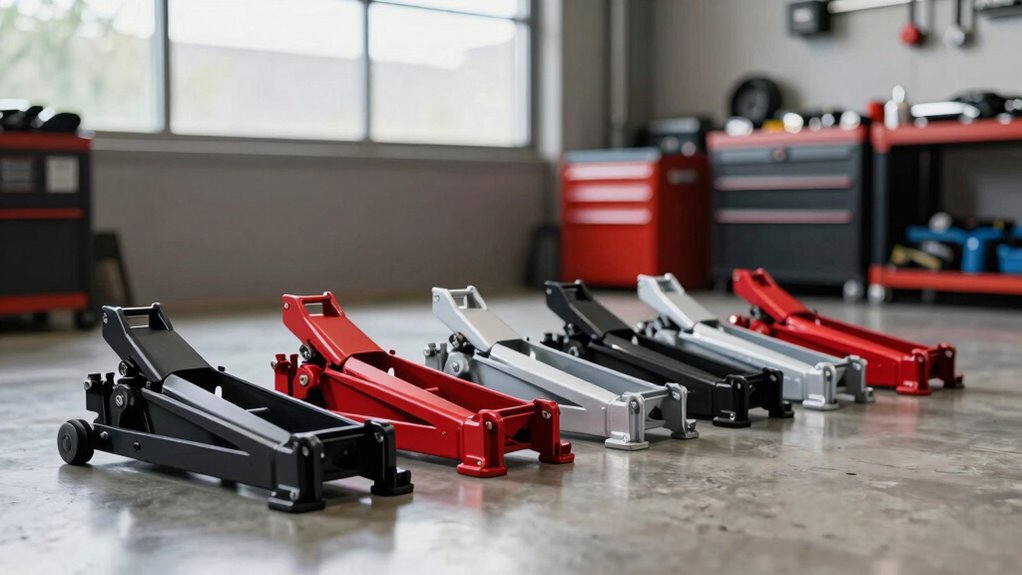

A low-profile floor jack needs to fit beneath your vehicle before it can lift it, so minimum height and capacity matter as much as pump speed. My best overall pick is the Jack Boss 3 Ton, which combines aluminum-and-steel construction with dual pistons and a quick-lift pump. For a steel-focused alternative, the SATA 3-Ton pairs an ultra-low profile with a dual-piston pump, while the AV Steel 2.5 Ton lists a 3.4-inch minimum height for cars and sedans. The main tradeoffs are lifting capacity versus jack weight, and low entry height versus the higher reach some vehicles need. Read on for the full comparison, buying advice, and picks by buyer type.

Get art and craft supplies delivered free with Prime
- Fast, free delivery on millions of items
- Prime Video, Amazon Music and more included
- Member-only deals all year
Key Takeaways
- The Jack Boss 3 Ton ranks first for its combination of 3-ton capacity, mixed aluminum-and-steel construction, dual pistons, and quick-lift pump.
- Minimum height varies in practical importance: the AV Steel 2.5 Ton lists a 3.4-inch starting height, while SATA specifically describes its 3-ton model as ultra-low profile.
- Capacity alone does not settle the choice: 1.5-ton options suit narrower lifting needs, while 2.5- and 3-ton models offer more capacity headroom but may be less convenient to move.
- Aluminum-and-steel designs stand apart from all-steel jacks for buyers weighing portability against a steel-focused build; the product names alone do not establish a specific weight advantage.
- The list includes two repeated model names—Maxority 3-Ton and DNA Motoring 2 Ton—so the blue DNA Motoring listing is distinguished by color, while the Maxority pair cannot be meaningfully separated on the supplied details.
| DNA Motoring Low Profile Hydraulic Trolley Service Floor Jack, 2 Ton Capacity |  | Best for Easy Maneuvering | Capacity: 2 tons (4,000 lbs) | Lifting range: 5.1–13 inches | Minimum height: 5.1 inches | VIEW ON AMAZON | See Our Full Breakdown |
| VEVOR 2.5 Ton Low Profile Heavy-Duty Steel Racing Floor Jack |  | Best for Low-Clearance Versatility | Load capacity: 2.5 tons | Minimum height: 3.35 inches | Maximum lifting height: 14.96 inches | VIEW ON AMAZON | See Our Full Breakdown |
| AV Steel 1.5 Ton Aluminum and Steel Low Profile Hydraulic Floor Jack |  | Best for Lightweight Portability | Capacity: 1.5 tons (3,000 lbs) | Lift range: 3-1/8–14 inches | Minimum saddle height: 3-1/8 inches | VIEW ON AMAZON | See Our Full Breakdown |
| Jack Boss 3 Ton Low Profile Aluminum and Steel Racing Floor Jack with Dual Pistons and Quick Lift Pump |  | Best for Higher Lifting Reach | Capacity: 3 tons (6,600 lbs) | Lifting range: 3-15/16–18-5/16 inches | Minimum height: 3-15/16 inches | VIEW ON AMAZON | See Our Full Breakdown |
| YELLOW JACKET 1.5 Ton Hydraulic Low Profile Floor Jack |  | Best for Vehicle Contact Protection | Lift capacity: 1.5 tons (3,300 lbs) | Lifting range: 3.5–14 inches (90–358 mm) | Material: Alloy steel and aluminum | VIEW ON AMAZON | See Our Full Breakdown |
| Tonda 2.5 Ton Low Profile Floor Jack, 5,000 Lb Hydraulic Car Jack |  | Best for Lightweight, Occasional Use | Load capacity: 2.5 tons (5,000 lb) | Minimum height: 3.35 in | Maximum lift height: 14.57 in | VIEW ON AMAZON | See Our Full Breakdown |
| SATA 3-Ton Heavy-Duty Steel Floor Jack with Ultra-Low Profile and Dual-Piston Quick Lift Pump |  | Best for Very Low-Clearance Vehicles | Load capacity: 3 tons (6,600 lb) | Minimum height: 2-11/16 in | Maximum height: 19-1/8 in | VIEW ON AMAZON | See Our Full Breakdown |
| 2.5 Ton Steel Low Profile Hydraulic Floor Jack |  | Best for a Simple 2.5-Ton Setup | Load capacity: 2.5 tons (5,000 lb) | Lifting range: 3-3/8 to 14-15/16 in | Maximum height with pads: 16.1 in | VIEW ON AMAZON | See Our Full Breakdown |
| VEVOR 3 Ton Low Profile Floor Jack |  | Best for Maximum Lift Range | Load capacity: 3 tons (6,600 lb) | Minimum height: 3.35 in (85 mm) | Maximum height: 19.69 in (500 mm) | VIEW ON AMAZON | See Our Full Breakdown |
| AV Steel Low Profile Floor Jack 3 Ton (6600 lbs), Heavy Duty Hydraulic Jack for Car |  | Best All-Round 3-Ton Range | Load capacity: 3 tons (6,600 lb) | Minimum height: 3-1/8 in | Maximum height: 19-7/8 in | VIEW ON AMAZON | See Our Full Breakdown |
| Maxority 3-Ton Low Profile Hydraulic Floor Jack with Dual Pistons |  | Best for Extra Lift Range | Brand: Maxority | Model: MAX1901-20MIX | Capacity: 3 tons (6,600 lb) | VIEW ON AMAZON | See Our Full Breakdown |
| AV Steel Low Profile Floor Jack 2.5 Ton (5000 lbs), Lift Range 3.4″ to 14.6″ for Cars & Sedans |  | Best for Low-Clearance Sedans | Capacity: 2.5 tons (5,000 lb) | Lift range: 3.4–14.6 inches | Minimum height: 3.4 inches | VIEW ON AMAZON | See Our Full Breakdown |
| Maxority 3-Ton Low Profile Hydraulic Floor Jack with Dual Pistons |  | Best for Red-Finish Buyers | Brand: Maxority | Model: MAX1901-20SR | Capacity: 3 tons (6,600 lb) | VIEW ON AMAZON | See Our Full Breakdown |
| DNA Motoring Low Profile Hydraulic Trolley Service Floor Jack, 2 Ton Capacity, Blue |  | Best for Light-Duty Garage Jobs | Capacity: 2 tons (4,000 lb) | Lifting range: 5.1–13 inches | Material: Heavy-duty steel | VIEW ON AMAZON | See Our Full Breakdown |
| floor jack low profile | Material | Dimensions | Minimum height | Capacity |
|---|---|---|---|---|
| DNA Motoring Low Profile Hydra | Heavy-duty steel | 10 x 19 x 8 inches | 5.1 inches | 2 tons (4,000 lbs) |
| VEVOR 2.5 Ton Low Profile Heav | Steel | 22.2 x 8.7 x 5.2 inches | 3.35 inches | — |
| AV Steel 1.5 Ton Aluminum and | Steel and aluminum | 23.2 x 11.02 x 6.3 inches | — | 1.5 tons (3,000 lbs) |
| Jack Boss 3 Ton Low Profile Al | Aluminum and steel | 28.3 x 13.7 x 7.8 inches | 3-15/16 inches | 3 tons (6,600 lbs) |
| YELLOW JACKET 1.5 Ton Hydrauli | Alloy steel and aluminum | 21.8 x 9.72 x 5.9 inches | — | — |
| Tonda 2.5 Ton Low Profile Floo | Carbon steel | 20 × 8.7 × 3.35 in | 3.35 in | — |
| SATA 3-Ton Heavy-Duty Steel Fl | Industrial-grade steel | 28.35 × 13.58 × 6.3 in | 2-11/16 in | — |
| 2.5 Ton Steel Low Profile Hydr | Steel | 25.39 × 11.81 × 7.87 in | — | — |
| VEVOR 3 Ton Low Profile Floor | Alloy steel | 31.7 × 15.8 × 8.3 in | 3.35 in (85 mm) | — |
| AV Steel Low Profile Floor Jac | Steel | 29-1/8 × 13-3/4 × 5-7/8 in | 3-1/8 in | — |
| Maxority 3-Ton Low Profile Hyd | Alloy steel | — | — | 3 tons (6,600 lb) |
| AV Steel Low Profile Floor Jac | Steel | — | 3.4 inches | 2.5 tons (5,000 lb) |
| Maxority 3-Ton Low Profile Hyd | High-strength steel | — | — | 3 tons (6,600 lb) |
| DNA Motoring Low Profile Hydra | Heavy-duty steel | — | — | 2 tons (4,000 lb) |
More Details on Our Top Picks
DNA Motoring Low Profile Hydraulic Trolley Service Floor Jack, 2 Ton Capacity
The DNA Motoring 2-ton suits car owners who want a straightforward low-profile jack that is easy to position around a home garage. Its 5.1-inch minimum height is higher than the VEVOR 2.5 Ton’s 3.35-inch entry point, so it is a weaker fit for very low sports cars, but it can work for many standard passenger cars. Swivel casters and a relatively compact 10 x 19-inch footprint help with repositioning, while overload protection adds a useful safeguard during lifting. The tradeoff is a 13-inch maximum height and 2-ton capacity: this is a car-focused tool, not a practical choice for trucks or large SUVs. Like any floor jack, it is for lifting, not holding a vehicle during extended work.
Pros:- Swivel casters make positioning and repositioning easier.
- 2-ton capacity is suited to many passenger-car lifting tasks.
- Overload protection provides an added safety feature.
- Compact 10 x 19-inch dimensions are manageable in a home garage.
Cons:- 5.1-inch minimum height is substantially higher than the VEVOR 2.5 Ton’s 3.35-inch entry point.
- 2-ton capacity is not intended for trucks or large SUVs.
- 13-inch maximum lift limits clearance compared with taller-reaching options in this lineup.
Best for: Owners of standard passenger cars who want a maneuverable jack for occasional garage lifting and do not need an especially low entry height.
Not ideal for: Sports-car owners with very low ground clearance, or anyone lifting trucks, large SUVs, or vehicles that need more than 13 inches of lift.
- Capacity:2 tons (4,000 lbs)
- Lifting range:5.1–13 inches
- Minimum height:5.1 inches
- Maximum height:13 inches
- Material:Heavy-duty steel
- Wheel type:Swivel casters
- Dimensions:10 x 19 x 8 inches
Our verdict“Choose this jack for routine passenger-car lifting when easy maneuvering matters more than ultra-low access or extra lifting height.”
VEVOR 2.5 Ton Low Profile Heavy-Duty Steel Racing Floor Jack
The VEVOR 2.5 Ton has the broadest useful combination of low entry and lifting reach among these five: its saddle starts at 3.35 inches and rises to 14.96 inches. That makes it a more flexible match for low-clearance cars than the DNA Motoring jack, whose minimum height is 5.1 inches, while its 2.5-ton rating also gives it more capacity for compatible vehicles. The steel construction and stated safety certifications suit buyers prioritizing a heavy-duty garage tool. Its main cost in convenience is weight: at 13.6 kg, it is less appealing to carry or frequently move than the aluminum-and-steel AV Steel 1.5 Ton. It still needs manual pumping, and capacity alone does not establish that every truck or SUV is a suitable lifting target.
Pros:- 3.35-inch minimum height accommodates lower vehicles than the DNA Motoring 2-ton.
- 2.5-ton capacity offers more headroom than the 1.5-ton options in this group.
- 14.96-inch maximum height provides a broad lifting range.
- Steel construction and stated safety certifications suit regular garage use.
Cons:- At 13.6 kg, it is less portable than the lighter aluminum-and-steel jacks here.
- Manual pumping requires physical effort.
- Its size and steel build are less convenient for buyers with limited storage space.
Best for: Home mechanics who need low entry for cars and want more capacity and lift range than a compact 1.5- or 2-ton jack provides.
Not ideal for: Buyers who need a lightweight jack to transport often, or owners of vehicles whose weight and approved lifting points exceed the jack’s capacity or fit.
- Load capacity:2.5 tons
- Minimum height:3.35 inches
- Maximum lifting height:14.96 inches
- Material:Steel
- Weight:13.6 kg
- Dimensions:22.2 x 8.7 x 5.2 inches
- Color:Yellow
Our verdict“Pick the VEVOR for low-clearance access and a useful capacity-and-height range if portability is not your priority.”
AV Steel 1.5 Ton Aluminum and Steel Low Profile Hydraulic Floor Jack
For drivers who move a jack between vehicles or storage areas, the AV Steel 1.5 Ton pairs a 33.1-pound weight with an unusually broad 3-1/8-to-14-inch lift range. Its low saddle is a better starting point for sports cars than the DNA Motoring 2-ton’s 5.1-inch minimum, and the dual-piston pump is intended to reduce the pumping needed to raise the load. The compromise is capacity: at 1.5 tons, it is aimed at passenger cars, not trucks, SUVs, or lifted vehicles. Compared with the YELLOW JACKET 1.5 Ton, this AV Steel model reaches slightly lower and is listed at a slightly higher maximum height, while the YELLOW JACKET includes a large rubber saddle and foam handle bumper. Choose based on clearance and protection priorities, not capacity.
Pros:- 3-1/8-inch minimum saddle height suits many low-clearance cars.
- 33.1-pound weight is easier to transport than the 58.5-pound Jack Boss 3-ton.
- Dual-piston pump is designed for quicker lifting.
- 14-inch maximum height gives it more reach than the DNA Motoring 2-ton.
Cons:- 1.5-ton capacity rules out many heavier vehicles and lifting needs.
- Its passenger-car focus offers less versatility than the VEVOR 2.5 Ton.
- At 33.1 pounds, it is portable relative to heavier jacks but not a very light carry.
Best for: Sports-car and passenger-car owners who value a relatively portable jack with a low saddle and do not need truck or SUV capacity.
Not ideal for: Owners of SUVs, trucks, lifted vehicles, or anyone who needs a higher-capacity jack for heavier lifting jobs.
- Capacity:1.5 tons (3,000 lbs)
- Lift range:3-1/8–14 inches
- Minimum saddle height:3-1/8 inches
- Material:Steel and aluminum
- Weight:33.1 pounds
- Dimensions:23.2 x 11.02 x 6.3 inches
- Pump:Dual piston
Our verdict“Choose this AV Steel model for a low-entry, easier-to-transport jack dedicated to passenger cars and sports cars.”
Jack Boss 3 Ton Low Profile Aluminum and Steel Racing Floor Jack with Dual Pistons and Quick Lift Pump
The Jack Boss 3 Ton is the capacity-and-reach pick for buyers whose vehicle and lifting points call for more than the compact options provide. It supports up to 3 tons and rises to 18-5/16 inches, exceeding the VEVOR 2.5 Ton’s 14.96-inch maximum and making it better suited to jobs where added height is useful. Its 3-15/16-inch minimum still qualifies as low profile, though it does not slip as low as the AV Steel 1.5 Ton’s 3-1/8-inch saddle. Dual pistons and a quick-lift pump are intended to speed raising, while aluminum-and-steel construction balances strength with reduced weight versus an all-steel design. At 58.5 pounds, however, it is the least convenient option here to move, and its substantial footprint needs storage room.
Pros:- 3-ton capacity is the highest among the five products reviewed here.
- 18-5/16-inch maximum height exceeds the lift reach of the other four options.
- Dual pistons and a quick-lift pump are designed to reduce lifting time.
- Rubber saddle is included to provide a contact surface between the jack and vehicle.
Cons:- 58.5-pound weight makes it cumbersome to transport or reposition.
- 3-15/16-inch minimum height is higher than the AV Steel 1.5 Ton’s 3-1/8-inch entry.
- 28.3 x 13.7-inch dimensions require more storage space than compact options.
Best for: Home mechanics working with compatible heavier vehicles who need up to 3-ton capacity and greater lift height for service access.
Not ideal for: Drivers of extremely low sports cars who need the lowest possible saddle, or buyers who need a jack that is easy to carry and store in a small space.
- Capacity:3 tons (6,600 lbs)
- Lifting range:3-15/16–18-5/16 inches
- Minimum height:3-15/16 inches
- Maximum height:18-5/16 inches
- Material:Aluminum and steel
- Weight:58.5 pounds
- Dimensions:28.3 x 13.7 x 7.8 inches
- Included components:Rubber saddle and two-piece handle
- Warranty:1 year
Our verdict“Choose the Jack Boss when higher capacity and substantial lift height outweigh portability and storage concerns.”
YELLOW JACKET 1.5 Ton Hydraulic Low Profile Floor Jack
The YELLOW JACKET 1.5 Ton is a passenger-car jack for buyers who want low entry plus a little extra care at the vehicle contact point. Its 3.5-inch minimum height fits many low-clearance cars, though the AV Steel 1.5 Ton goes lower at 3-1/8 inches. Both use a dual-piston pump and offer a 14-inch maximum lift, so the choice turns more on details: YELLOW JACKET includes a large rubber saddle and foam handle bumper, while AV Steel lists a lower starting height. The 31.5-pound aluminum-and-steel construction is also the lightest of these five by the listed weights. Its 1.5-ton capacity limits it to suitable passenger-car jobs, and 14 inches may not provide enough lift for every service setup.
Pros:- 3.5-inch minimum height suits many low-clearance passenger cars.
- 31.5-pound listed weight is lower than the other four jacks in this group.
- Dual-piston pump is designed to lift faster than a single-pump arrangement.
- Large rubber saddle and foam handle bumper add vehicle-contact protection.
Cons:- 1.5-ton capacity is not suited to many SUVs, trucks, or heavier vehicles.
- AV Steel’s 3-1/8-inch minimum height provides better access for cars with especially low clearance.
- 14-inch maximum height may not suit jobs that need greater lift.
Best for: Passenger-car owners who want a relatively lightweight, low-profile jack with a rubber saddle and handle bumper to help protect vehicle surfaces.
Not ideal for: SUV and truck owners, or sports-car owners whose ground clearance is below 3.5 inches and requires a lower saddle.
- Lift capacity:1.5 tons (3,300 lbs)
- Lifting range:3.5–14 inches (90–358 mm)
- Material:Alloy steel and aluminum
- Weight:31.5 pounds
- Dimensions:21.8 x 9.72 x 5.9 inches
- Model number:AS815016L
- Safety standard:ANSI/ASME
- Warranty:1 year manufacturer warranty
Our verdict“Pick the YELLOW JACKET for a lighter passenger-car jack with useful contact-protection features, provided its 3.5-inch entry height fits your vehicle.”
Tonda 2.5 Ton Low Profile Floor Jack, 5,000 Lb Hydraulic Car Jack
The Tonda is a straightforward choice for owners of sedans, coupes, and smaller SUVs who need a low-profile jack without stepping up to a 3-ton unit. Its 3.35-inch minimum height suits many low cars, while the 2.5-ton capacity covers a broad range of routine vehicle work. Compared with the SATA 3-Ton, it gives up both capacity and lifting reach, but its listed weight of 12.8 kg is far easier to manage than that model’s 70 pounds. The tradeoff is a maximum lift of 14.57 inches, which may not provide enough clearance for some jobs, and the product details list no accessories. I’d choose it for simpler home-garage tasks, not for frequent work on heavier vehicles or situations that call for a taller lift.
Pros:- 2.5-ton capacity suits many cars and smaller SUVs
- 3.35-inch minimum height fits many low-clearance vehicles
- Listed weight of 12.8 kg is lighter than the 70-pound SATA
- Large wheels and swivel casters help with positioning
Cons:- 14.57-inch maximum lift may not provide enough clearance for some repairs
- Lower capacity than the 3-ton options in this group
- No accessories or added features are specified
Best for: Owners of sedans and coupes who want a relatively manageable steel jack for occasional home-garage lifting.
Not ideal for: People lifting heavier vehicles or needing extra working height; its 2.5-ton capacity and 14.57-inch maximum lift are more limited than the 3-ton SATA and VEVOR options.
- Load capacity:2.5 tons (5,000 lb)
- Minimum height:3.35 in
- Maximum lift height:14.57 in
- Material:Carbon steel
- Item weight:12.8 kg
- Dimensions:20 × 8.7 × 3.35 in
- Color:Blue
Our verdict“Choose the Tonda for occasional work on lighter vehicles when easier handling matters more than a 3-ton capacity or tall lift.”
SATA 3-Ton Heavy-Duty Steel Floor Jack with Ultra-Low Profile and Dual-Piston Quick Lift Pump
The SATA stands apart on access: its 2-11/16-inch minimum height is the lowest listed in this five-jack group, making it the clearest pick for cars that sit especially close to the ground. It also pairs a 3-ton capacity with a dual-piston pump, so lifting a compatible vehicle should take fewer pump strokes than a basic single-piston design. Compared with the AV Steel 3 Ton, the SATA starts lower, while both offer a high maximum lift; the AV Steel’s listed range reaches slightly higher. The main compromise is portability: at 70 pounds, this is a shop-oriented jack rather than one I’d want to move often or store in a tight space. Its low entry height also does not replace checking clearance at the actual lifting point.
Pros:- 2-11/16-inch minimum height is the lowest among these five options
- 3-ton capacity handles more load than the 2.5-ton Tonda and steel jack
- Dual-piston pump is designed to reduce lifting effort and time
- Controlled lowering and overload protection are specified
Cons:- 70-pound weight makes it cumbersome to carry or reposition
- Its entry height still needs to match the vehicle’s lifting-point clearance
- The listed maximum height is lower than the AV Steel 3 Ton’s 19-7/8 inches
Best for: Owners of very low-clearance cars and home mechanics who can keep a heavy jack in a dedicated garage workspace.
Not ideal for: Drivers who need a portable jack or frequently move equipment between locations; its 70-pound weight makes repositioning less convenient than the lighter Tonda.
- Load capacity:3 tons (6,600 lb)
- Minimum height:2-11/16 in
- Maximum height:19-1/8 in
- Pump:Dual-piston quick-lift pump
- Material:Industrial-grade steel
- Item weight:70 lb
- Dimensions:28.35 × 13.58 × 6.3 in
Our verdict“Pick the SATA when getting under an especially low car matters more than keeping the jack light and easy to move.”
2.5 Ton Steel Low Profile Hydraulic Floor Jack
This steel jack is a practical middle ground for buyers who want 2.5-ton capacity and a useful lifting range without the bulk of the 3-ton VEVOR. Its 3-3/8-inch minimum height is close to the Tonda’s 3.35 inches, so neither has a clear advantage for very low cars; the Tonda lists swivel casters, while this model gives a 14-15/16-inch range and a specified 2.2-inch saddle diameter. That range suits many ordinary lifting tasks, but it falls well short of the VEVOR’s 19.69-inch maximum. At 33.4 pounds, it is lighter than the VEVOR and SATA, though still substantial to carry. I’d favor it for routine work on lighter vehicles, with the caveat that no warranty is included in the supplied details.
Pros:- 2.5-ton capacity fits many passenger vehicles
- 3-3/8-inch minimum height is suited to many low-clearance cars
- 33.4-pound weight is lower than the SATA and VEVOR listings
- Saddle diameter is specified at 2.2 inches
Cons:- Maximum lift of 14-15/16 inches is limited compared with the 3-ton options
- 33.4 pounds may still be awkward for frequent carrying
- No warranty is included in the supplied product details
Best for: Home mechanics lifting cars or smaller SUVs who want a steel 2.5-ton jack and do not need a high maximum lift.
Not ideal for: Owners of heavier vehicles or anyone needing extra clearance for repair work; the 2.5-ton rating and 14-15/16-inch lifting range trail the 3-ton VEVOR.
- Load capacity:2.5 tons (5,000 lb)
- Lifting range:3-3/8 to 14-15/16 in
- Maximum height with pads:16.1 in
- Saddle diameter:2.2 in
- Material:Steel
- Item weight:33.4 lb
- Dimensions:25.39 × 11.81 × 7.87 in
Our verdict“Choose this jack for ordinary lifting on lighter vehicles if its moderate height range is enough for your work.”
VEVOR 3 Ton Low Profile Floor Jack
The VEVOR is the strongest match here for buyers who need both 3-ton capacity and substantial lift height: its stated range runs from 3.35 to 19.69 inches. That extra reach gives it an advantage over the 2.5-ton Tonda and steel jack for jobs requiring more clearance, while its dual pistons are intended to speed the lift. The tradeoff is a 73-pound body, heavier than the SATA and not a natural pick for frequent relocation. Its 3.35-inch minimum height also sits well above the SATA’s 2-11/16 inches, so the VEVOR may not fit under the very lowest vehicles. I’d choose it for a fixed garage where lift range and capacity matter more than portability, after checking the vehicle’s clearance at the jack point.
Pros:- 3-ton capacity covers more load than the 2.5-ton options
- 19.69-inch maximum height is the greatest listed among these five jacks
- Dual-piston design is intended for quicker lifting
- Alloy-steel construction and safety certification are specified
Cons:- 73-pound weight makes it difficult to carry and reposition
- 3.35-inch minimum height may not fit the lowest vehicles
- Some assembly is required for storage
Best for: Home-garage users lifting cars, trucks, or SUVs who need 3-ton capacity and a tall maximum lift, with little need to carry the jack.
Not ideal for: Owners of extremely low cars or people who need to move a jack frequently; its 3.35-inch entry height is higher than the SATA’s and its listed weight is 73 pounds.
- Load capacity:3 tons (6,600 lb)
- Minimum height:3.35 in (85 mm)
- Maximum height:19.69 in (500 mm)
- Material:Alloy steel
- Item weight:73 lb
- Dimensions:31.7 × 15.8 × 8.3 in
- Color:Yellow
Our verdict“Pick the VEVOR for a stationary garage setup where high lift and 3-ton capacity matter more than low entry height or easy portability.”
AV Steel Low Profile Floor Jack 3 Ton (6600 lbs), Heavy Duty Hydraulic Jack for Car
The AV Steel offers a useful balance for buyers who want 3-ton capacity without choosing between a low entry point and a tall lift. Its 3-1/8-inch minimum is lower than the VEVOR’s 3.35 inches, while its 19-7/8-inch maximum edges past the VEVOR’s listed 19.69 inches. The dual-piston pump is designed for quicker lifting, and two rear rotating wheels should help with positioning. Compared with the SATA, the AV Steel starts higher, so it is less suited to the very lowest cars; the SATA also gives clearer details about controlled lowering. The AV Steel listing does not specify item weight or pump-handle details, making portability harder to judge. I’d favor it for mixed garage work where capacity and height range take priority over fully documented handling details.
Pros:- 3-ton capacity suits a wider range of vehicles than the 2.5-ton jacks
- 3-1/8-inch minimum height is lower than the VEVOR’s 3.35 inches
- 19-7/8-inch maximum height is the highest listed in this group
- Dual pistons and two rear rotating wheels support faster lifting and repositioning
Cons:- Minimum height is higher than the SATA’s 2-11/16 inches
- Item weight is not specified, so portability is difficult to judge
- Handle and pump-mechanism details are limited in the supplied information
Best for: Home mechanics who lift a mix of cars and larger vehicles and want a 3-ton jack with a broad height range and rear rotating wheels.
Not ideal for: Owners of cars with extremely low lifting points or buyers who need a clearly stated weight and detailed handling specifications; the SATA starts lower, and AV Steel does not list its weight here.
- Load capacity:3 tons (6,600 lb)
- Minimum height:3-1/8 in
- Maximum height:19-7/8 in
- Lifting range:3-1/8 to 19-7/8 in
- Material:Steel
- Dimensions:29-1/8 × 13-3/4 × 5-7/8 in
- Wheels:Two rear rotating wheels
Our verdict“Choose the AV Steel for broad-range 3-ton garage use if its 3-1/8-inch entry height clears your vehicle.”
Maxority 3-Ton Low Profile Hydraulic Floor Jack with Dual Pistons
The Maxority MAX1901-20MIX pairs low-profile access with a stated 19.9-inch maximum lift, making it a stronger fit for buyers who need more vertical reach than the AV Steel 2.5-ton jack’s 14.6-inch ceiling. Its 3-ton capacity and dual-piston rapid-pump design suit frequent garage jobs where fewer pumping strokes can save time. The alloy-steel build favors durability, though it also means this is not the lightweight choice in the lineup. The main caveat is the 90-day warranty, which gives less coverage than many buyers may want for a heavy-use tool. Color is supplied at random, so appearance is not selectable. Choose it for capacity and reach, but skip it if warranty length or a known color matters more.
Pros:- 3-ton capacity suits a broad range of passenger vehicles
- Low-profile design is intended for lowered vehicles and sports cars
- Dual-piston rapid pump can reduce the number of strokes needed
- 19.9-inch maximum height offers more reach than the AV Steel 2.5-ton jack
Cons:- 90-day warranty is short for a heavy-duty shop tool
- Random color selection removes control over the finish
- Product data does not specify minimum height, limiting fit checks for extremely low vehicles
Best for: Home mechanics working on low-clearance cars who want 3-ton capacity and more lift height than a compact sedan-focused jack provides.
Not ideal for: Buyers who need long warranty coverage, a specific color, or a jack whose weight and dimensions are confirmed before purchase.
- Brand:Maxority
- Model:MAX1901-20MIX
- Capacity:3 tons (6,600 lb)
- Maximum lifting height:19.9 inches
- Material:Alloy steel
- Pump design:Dual pistons with RAPID PUMP technology
- Warranty:90 days
- Color:Random
Our verdict“Choose this Maxority if you want a low-profile 3-ton jack with substantial stated lift height and can accept a short warranty.”
AV Steel Low Profile Floor Jack 2.5 Ton (5000 lbs), Lift Range 3.4″ to 14.6″ for Cars & Sedans
For passenger-car owners, the AV Steel offers a clearly stated 3.4-inch minimum height and a 14.6-inch maximum, so buyers can compare its reach with their vehicle before choosing. Its 2.5-ton rating is below the 3-ton Maxority models, but that smaller capacity aligns with its stated focus on cars and sedans rather than heavier vehicles. At 30 pounds, it is also a relatively defined, manageable option for a home garage, with rear rotating wheels for repositioning. The tradeoff is limited lift height: it cannot match the Maxority’s 19.9-inch figure. I would also verify the vehicle’s lift points and clearance, since low-profile design alone does not guarantee fit.
Pros:- Specified 3.4-inch minimum height helps buyers check low-clearance fit
- 2.5-ton capacity is suited to many passenger-car jobs
- Rear rotating wheels aid positioning
- 30-pound item weight is stated for easier handling planning
Cons:- 14.6-inch maximum height is well below the 19.9-inch reach listed for the Maxority 3-ton models
- Not intended for trucks or SUVs
- Vehicle compatibility and lift-point clearance still need checking
Best for: Sedan and passenger-car owners who want a specified low entry height, a moderate 2.5-ton rating, and a jack that can be repositioned around a home garage.
Not ideal for: Truck and SUV owners, or anyone who needs more than 14.6 inches of lift for their service tasks.
- Capacity:2.5 tons (5,000 lb)
- Lift range:3.4–14.6 inches
- Minimum height:3.4 inches
- Maximum height:14.6 inches
- Material:Steel
- Item weight:30 pounds
- Item dimensions:23.38 × 9.21 × 6.26 inches
- Safety feature:Overload protection
Our verdict“Pick the AV Steel for compatible sedans when its 3.4-to-14.6-inch range suits your lifting points and work needs.”
Maxority 3-Ton Low Profile Hydraulic Floor Jack with Dual Pistons
This red Maxority shares the key working claims of the MAX1901-20MIX: 3-ton capacity, low-profile access, dual-pump speed, and a listed 19.9-inch maximum height. Its distinct advantage in this batch is the specified red finish, while the other Maxority listing gives a random color. That makes this version easier to match to a garage setup, but the available data does not establish a performance difference between the two. Compared with the AV Steel 2.5-ton jack, it offers greater stated capacity and height; compared with the DNA Motoring 2-ton jack, it is aimed at heavier vehicle work, though neither should replace properly rated stands for support. The 90-day warranty and need for some pumping effort temper its appeal for frequent professional use.
Pros:- 3-ton capacity exceeds the AV Steel 2.5-ton and DNA Motoring 2-ton ratings
- Dual-pump RAPID PUMP design is intended to reduce lifting strokes
- 19.9-inch maximum height provides useful stated reach
- Red color is specified rather than randomly assigned
Cons:- 90-day warranty offers limited coverage
- Some physical effort is still required to operate the pump
- No minimum height is supplied in the product data for checking very low vehicles
Best for: Home or small-shop mechanics who want a red, steel 3-ton low-profile jack with dual-pump operation for compatible cars.
Not ideal for: Buyers seeking extended warranty coverage, a lightweight jack, or a confirmed minimum clearance measurement before ordering.
- Brand:Maxority
- Model:MAX1901-20SR
- Capacity:3 tons (6,600 lb)
- Maximum lifting height:19.9 inches
- Material:High-strength steel
- Style:Dual pump
- Color:Red
- Warranty:90 days
Our verdict“Choose this version over the color-unspecified Maxority if a red finish matters and its 3-ton rating fits your vehicle.”
DNA Motoring Low Profile Hydraulic Trolley Service Floor Jack, 2 Ton Capacity, Blue
The DNA Motoring is the lightest-duty choice here, with a 2-ton capacity and a 5.1-to-13-inch lift range. That narrower range makes it a better match for routine work on compatible cars than for lowered vehicles needing especially low entry clearance or extra height. The Maxority jacks provide a 3-ton rating and a much higher listed maximum, while the AV Steel starts at 3.4 inches and reaches 14.6 inches; the DNA’s stated range trails both on reach. Its swivel casters and overload protection support basic garage use, but the supplied data does not state a minimum height as low as the sedan-focused AV Steel. It is for lifting only, not holding a vehicle for extended periods; use properly rated stands after raising a vehicle.
Pros:- Swivel casters help with positioning in a garage
- Overload protection is included
- Steel construction is suited to routine lifting tasks
- Blue finish is specified
Cons:- 2-ton capacity is lower than the 2.5-ton AV Steel and 3-ton Maxority options
- 5.1-inch minimum height may rule it out for some low-clearance vehicles
- 13-inch maximum height limits access compared with the other reviewed jacks
Best for: DIY car owners who need a straightforward trolley jack for compatible, lighter passenger vehicles and value easy positioning over extra capacity or lift height.
Not ideal for: Truck and large-SUV owners, drivers of extremely low cars, or anyone needing more than 13 inches of lift.
- Capacity:2 tons (4,000 lb)
- Lifting range:5.1–13 inches
- Material:Heavy-duty steel
- Color:Blue
- Weight:9.66 kg
- Safety feature:Overload protection
- Mobility:Swivel casters
- Intended use:Garage and industrial lifting; not for extended load support
Our verdict“Choose the DNA Motoring for basic lifting of compatible cars if its 5.1-to-13-inch range and 2-ton capacity are sufficient.”

How We Picked
I ranked these jacks by how well their stated specifications address the central challenge of this category: fitting under a low vehicle while providing suitable capacity and usable lift. I gave extra weight to explicit low-height claims, listed capacity, and features with a clear practical role, such as dual pistons and quick-lift pumps. Construction also shaped the order: aluminum-and-steel models may appeal to buyers balancing portability and strength, while steel models suit shoppers who prefer an all-steel design.
The ranking reflects only the supplied product names and stated features, not hands-on testing or unlisted specifications. That means a model with a specific height range or clearly described pump earns a stronger place than one whose listing gives fewer decision-making details. I also account for buyer fit: lighter-duty options are not interchangeable with 3-ton models, and duplicated product names are not treated as distinct performers without evidence of a meaningful difference.
Factors to Consider When Choosing Floor Jack Low Profile
Choosing a low-profile jack involves more than finding the lowest number in a listing. I would match the jack to the vehicle, the lifting points, and the space where it will be stored and used. These checks can help prevent a common mismatch: a jack that is low enough to enter but lacks the needed reach, or one with ample capacity that is awkward for the owner to position.
Check clearance at the actual lifting point
Measure from the floor to the vehicle’s intended jack point on level ground, rather than relying on the car’s advertised ground clearance. Bodywork, side skirts, and suspension position can make the usable opening lower than expected. Leave a small margin so the jack can roll into place without scraping or binding. A listed minimum height is useful only if it refers to the jack’s lifting saddle and fits your access path. If the vehicle is lowered, confirm the exact minimum height before choosing based on the phrase “low profile.”
Match capacity to the job, not the vehicle’s total weight alone
A floor jack lifts one part of a vehicle at a time, so the vehicle’s full curb weight is not the same as the load on the jack. Even so, choosing capacity without a suitable margin can leave little room for variations in load or setup. Use the vehicle maker’s lifting guidance and account for any equipment or modifications that add weight. A 1.5-ton jack may fit a narrower set of jobs, while 2.5- and 3-ton models give broader capacity headroom. Never work beneath a vehicle supported only by a hydraulic jack; use correctly rated jack stands on stable ground.
Compare minimum height with maximum reach
Low entry height solves only half the fit problem: the jack also needs to raise the vehicle far enough for the task. Check both ends of the lift range when the manufacturer provides them, and compare the maximum lift with your jack stands and intended service work. A model that fits beneath a sedan may still fall short for a particular lifting point or tire-change setup. Avoid assuming that a low-profile label means an unusually high maximum lift. If a listing omits the range, seek the manufacturer’s specification before purchasing.
Decide whether portability matters more than an all-steel build
Steel models can appeal to buyers who want a steel-focused design, while aluminum-and-steel models may suit owners who need to move a jack around a garage or transport it. Do not infer actual weight from the materials alone; check the listed product weight and dimensions. A jack that is hard to lift or steer can become inconvenient even if its capacity looks generous. On the other hand, a portable design does not remove the need to check rated capacity, stability, and approved lifting points. Choose around your storage and handling needs, not material labels by themselves.
Treat quick-lift features as a convenience, not a safety shortcut
Dual-piston and quick-lift pump descriptions suggest a design intended to raise the saddle with fewer pumping strokes before it contacts the vehicle. That can save time during repeated lifting, but it does not tell you how the jack behaves under load or replace careful positioning. For occasional home maintenance, a simpler pump may be adequate if the jack fits the vehicle and task. For frequent use, a faster pumping arrangement may matter more, though serviceability and manufacturer support deserve attention too. Always follow the jack’s operating instructions and lower the vehicle onto rated stands before working underneath.
Verify the details that listings leave out
Product titles do not answer every ownership question. Before buying, check the official specifications for overall dimensions, weight, saddle size, lift range, release control, warranty, and replacement-part availability. Confirm that the product is a floor jack rather than a similarly named accessory, and make sure the lifting points and floor surface suit its design. Be cautious when two listings share the same model name: color or capacity wording alone may not signal a different jack. When a critical measurement is absent, choose a better-documented option or request confirmation from the seller.
Frequently Asked Questions
How low does a floor jack need to be for my car?
Measure the clearance between the floor and the specific lifting point you plan to use, with the vehicle parked on level ground. The jack’s saddle must fit beneath that point, and the jack body needs room to roll into position. Do not use ground clearance figures as a substitute for measuring the access point, especially on lowered cars or vehicles with side skirts. The AV Steel 2.5 Ton listing gives a 3.4-inch minimum, but that measurement may not suit every low vehicle. Compare the manufacturer’s minimum height with your own measurement before deciding.
Is a 2-ton floor jack enough for a sedan?
It can be suitable for some sedan lifting tasks, but the right capacity depends on the vehicle, the lifting point, and the manufacturer’s guidance. A jack lifts only a portion of the vehicle at a time, yet buyers should still choose a rated model with an appropriate margin for their use. The 2-ton DNA Motoring models are lower-capacity options in this roundup than the 2.5- and 3-ton choices. Check your vehicle manual and the jack’s rated capacity rather than deciding from the word “sedan” alone. Use rated stands after lifting, and never rely on the jack as the sole support.
Should I choose an aluminum-and-steel jack or an all-steel model?
The choice depends on how often you move the jack and what construction you prefer, not on material labels alone. Aluminum-and-steel models in this roundup include the Jack Boss 3 Ton and AV Steel 1.5 Ton, while several alternatives are identified as steel. Mixed-material construction may appeal to buyers balancing handling and a substantial build, but confirm the actual weight and specifications before assuming it will be easier to carry. Steel models may suit shoppers who specifically want a steel-focused design. Capacity, minimum height, lift range, and stability should still lead the decision.
Do dual pistons make a floor jack a better choice?
Dual pistons and quick-lift pumps are useful convenience features when reducing the number of pump strokes matters. The Jack Boss 3 Ton, SATA 3-Ton, and Maxority 3-Ton listings call out dual-piston or quick-lift designs. Those descriptions do not establish lifting speed under every load, durability, or suitability for a particular vehicle. For occasional maintenance, accurate fit and adequate capacity may matter more than pump design. If you lift vehicles often, compare the pump feature alongside service support, lift range, and the manufacturer’s operating instructions.
What should I do when two listings appear to be the same floor jack?
Compare the complete model number and official specifications rather than treating repeated titles as separate designs. This roundup includes two Maxority 3-Ton entries with the same supplied description, so there is no stated feature difference to support ranking one above the other. The DNA Motoring entries share a 2-ton description, with one specifically listed in blue; color alone does not establish a performance difference. Check dimensions, weight, capacity, warranty, and included components for any actual variation. If those details match, choose based on availability and seller support rather than assuming one version is superior.
Conclusion
For the broadest mix of stated capacity and convenience features, I recommend the Jack Boss 3 Ton as best overall. Buyers prioritizing a listed low entry height for a car or sedan should start with the AV Steel 2.5 Ton, while the SATA 3-Ton is a strong candidate for shoppers seeking an ultra-low-profile steel jack with a dual-piston pump. My best premium-style pick is also the Jack Boss, based on its aluminum-and-steel construction and quick-lift features; the supplied details do not establish a separate luxury tier. For beginners, the VEVOR 2.5 Ton offers a middle-capacity option to compare, but I would verify its height and lift range before buying. For a specific need such as a lower-capacity jack, consider the DNA Motoring 2 Ton or YELLOW JACKET 1.5 Ton, provided the rated capacity matches your vehicle and task. Check the manufacturer’s measurements and use jack stands whichever model you choose.